 English
 العربية
 Deutsch
 Español
 Français
 हिन्दी
 Bahasa Indonesia
 Italiano
 日本語
日本語 한국어
한국어 Polski
 Português (Brasil)
 Русский
 Türkçe
 Українська
 简体中文
简体中文Learn
A typical cloud can hold hundreds of tonnes of water
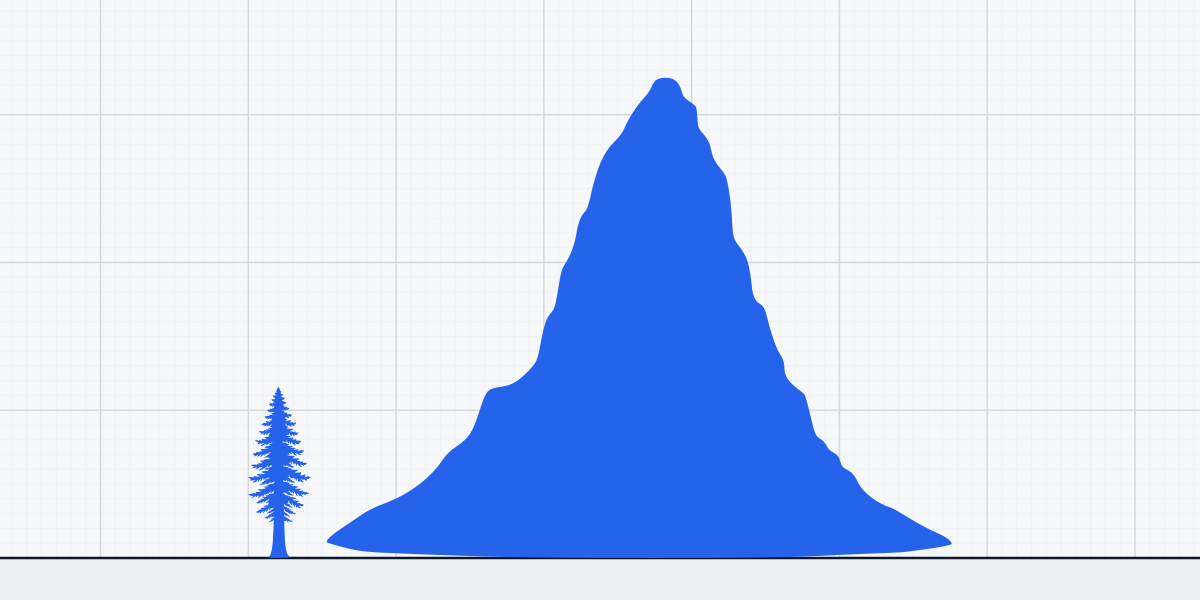
A fair-weather cumulus can hold about 500 metric tonnes of liquid water if its volume is roughly 1 km³. That estimate follows from about 0.5 g of liquid water per cubic metre, multiplied across the cloud; the U.S. Geological Survey’s cloud-weight estimate (opens in a new tab) uses this kind of calculation.
That total sounds like a load of water ready to fall. But the estimate counts liquid water dispersed as tiny droplets, not a pool or a solid mass. The rest of the cloud’s volume is air, and that air matters to why the droplets stay aloft.
First, give the cloud a volume
Cloud shapes have lumpy tops and flatter bases, and their edges fade into clear sky. For a workable estimate, picture a fair-weather cumulus about 1 km across, 1 km deep and 1 km tall. Treating it as a cube gives a volume of about 1 km³, or 1 billion m³. The National Weather Service’s guide to clouds (opens in a new tab) explains how rising, moist air forms clouds.
This model smooths over differences within the cloud: some patches hold more droplets than others, while faint edges blend into the surrounding air. Applying an average water content across the whole volume makes the arithmetic manageable without claiming that every part of the cloud looks or holds the same.
A span of 1 km is easy to picture beside a landmark. The Burj Khalifa reaches 828 m (2,720 ft); set that tower beside the cloud’s estimated width, and it would not quite reach from one side to the other. The cloud’s horizontal extent is a broad patch overhead, not a tower standing on the ground.
Natural landmarks give another sense of scale. Big Daddy Dune rises 325 m (1,070 ft), about 2.8 times the height of Hyperion, the 116 m (380 ft) redwood. Their different silhouettes make the cloud’s kilometre-wide span easier to contrast with heights measured from the ground.
Multiply the volume by the water in it
The model assigns about 0.5 g of liquid water (opens in a new tab) to each cubic metre. Multiply that amount by the cloud’s 1 billion m³: 0.5 g/m³ × 1,000,000,000 m³ = 500,000,000 g. That is 500,000 kg, or about 500 metric tonnes of liquid water.
Another way to follow the calculation is to imagine the cloud divided into cubes, each 1 m along every edge. Each cube contributes only half a gram of water, but the model contains 1 billion of those cubic metres. A small amount repeated across a huge volume produces the large total.
This is the same basic method used in estimation tips: choose a volume, estimate how much is in each unit of it, then multiply. The result is an estimate of liquid water alone. It does not count the air filling the same space.
The cloud also contains an enormous amount of air
Near sea level, a cubic metre of air has a mass of about 1.2 kg (opens in a new tab). The model’s 1 billion m³ would therefore contain about 1.2 billion kg of air, or 1.2 million metric tonnes. That is roughly 2,400 times the mass of the estimated liquid water.
The droplets are mixed through that air; they do not replace it. Moist air can also be less dense than drier air around it, as the U.S. Geological Survey explains. Water vapour is lighter than the nitrogen and oxygen molecules it displaces, while temperature differences also affect whether air rises or sinks.
So the cloud is not held up by a hidden shell. It is a region of the atmosphere where water droplets are carried along with moving air. The total mass of water can be large while each part of the cloud remains a thin mist within a much larger volume of air.
Why hundreds of tonnes of water do not fall at once
A typical cloud droplet is around 20 micrometres across (opens in a new tab). A human hair is about 70 µm wide, so each droplet is far smaller than the familiar strand. Gravity pulls droplets down, but their tiny size means air resistance slows their fall; rising currents and turbulence can keep them moving with the air.
Clouds form as moist air rises and cools, allowing water to condense into droplets. Where the air moves or dries, droplets evaporate and the visible edge fades. The bright, distinct crown of a cumulus and its ragged border are signs of changing air and moisture, not a fixed outline.
When droplets or ice particles grow large enough, they can fall as rain or other precipitation. That process differs from the lift of airships and balloons, which depends on buoyancy inside an envelope. A cloud has no envelope; its droplets travel with the air around them.
Look at a cumulus from the ground: its white crown stands out against blue sky, while its ragged edge thins until the mist disappears from view.
Related sizes
Things this article is about, with their sizes.
Sources
- U.S. Geological Survey: How Much Does a Cloud Weigh? (opens in a new tab) usgs.gov
- National Weather Service: Clouds and Contrails (opens in a new tab) weather.gov
- Namib-Naukluft National Park — Sossusvlei and Big Daddy; Atlas Obscura — Big Daddy Dune
- Guinness World Records — Tallest tree (living); Redwood National and State Parks — Hyperion
- NASA Glenn Research Center — Properties of Air (opens in a new tab) www1.grc.nasa.gov
- UCAR Center for Science Education — Sizes of Aerosols, Raindrops and Cloud Droplets (opens in a new tab) scied.ucar.edu