 English
 العربية
 Deutsch
 Español
 Français
 हिन्दी
 Bahasa Indonesia
 Italiano
 日本語
日本語 한국어
한국어 Polski
 Português (Brasil)
 Русский
 Türkçe
 Українська
 简体中文
简体中文Learn
Why does an avocado have such a huge seed?
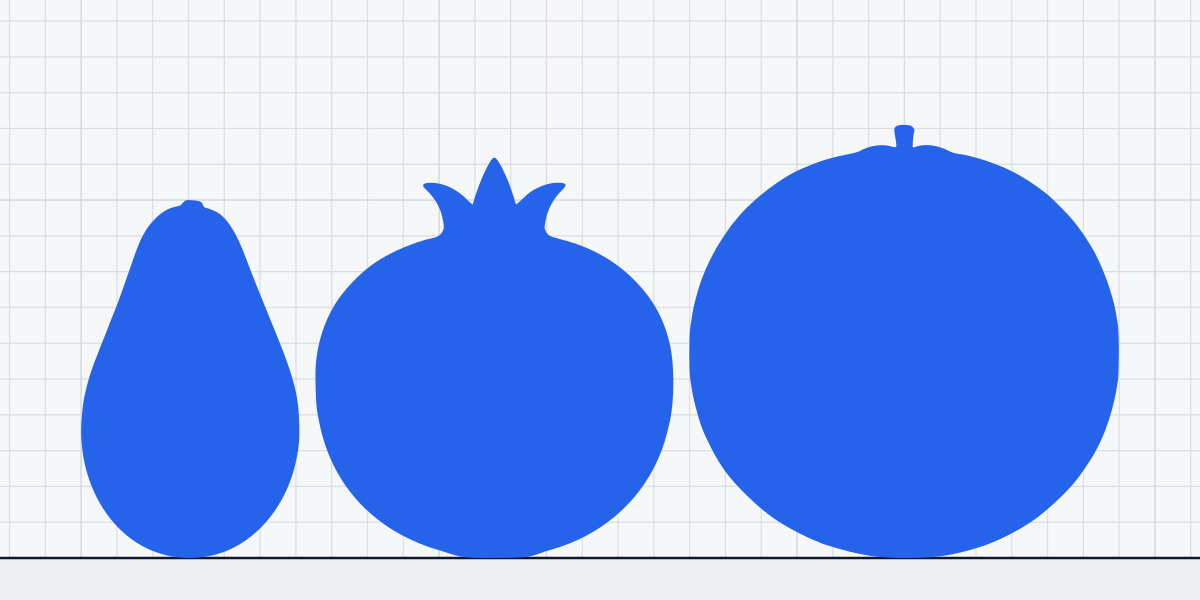
The avocado seed may be so large because its stored food can help a seedling grow in shade; a typical pit measures about 3–4 cm (1.2–1.6 in) (opens in a new tab) across. The fruit is about 10 cm (3.9 in) tall, while a proposed Ice Age disperser, Megatherium, stood about 3.5 m (11 ft) tall.
A big seed inside an avocado fruit
Botanically, an avocado is a single-seeded berry, even though cooks often treat it as a vegetable. The Fruits & Nuts category includes produce with very different interiors: the avocado has one central seed, while a pomegranate can contain hundreds of juicy seed coverings called arils beneath its leathery rind. A grapefruit, about 12 cm (4.7 in) wide, has segmented citrus flesh rather than a single central pit.
A large seed is a conspicuous investment inside a fruit eaten for its soft flesh. That raises two different questions: what the stored food does for a young avocado, and why the fruit and seed may have evolved in this form. The first has a straightforward biological explanation; the second may involve animals that no longer exist.
How a large seed helps a seedling
When a seed germinates, its embryo begins growing before its leaves can supply all the energy it needs. Stored reserves help build the young plant’s roots and shoots, giving it material to grow while its leaves develop and begin making sugars from sunlight. The avocado’s sizeable pit is a ready supply of those reserves beside the developing sprout.
Light can be scarce beneath a forest canopy. A seedling growing in deep shade may have to keep developing roots and stems before its leaves reach a brighter opening. Reserves in a large seed can support that early growth; they cannot replace sunlight, but they can help the plant grow until its leaves take over more of the work.
That supply has a cost to the parent tree, which must put resources into producing each seed. A large reserve makes sense if it improves a seedling’s chances in the conditions where it grows. Shade is a plausible benefit, not a complete explanation for the avocado’s pit: seedling growth describes what the seed can do, while the fruit’s evolutionary history may involve a separate advantage.
Could Ice Age giants have spread avocados?
The megafaunal-dispersal hypothesis proposes that large mammals ate ancestral avocado fruits whole and carried the seeds away from the parent plant. If a seed passed through an animal and was deposited in dung, it could land in a new patch of ground, beyond the shade and competition close to its parent. A large fruit could, in theory, attract an animal capable of moving its seed.
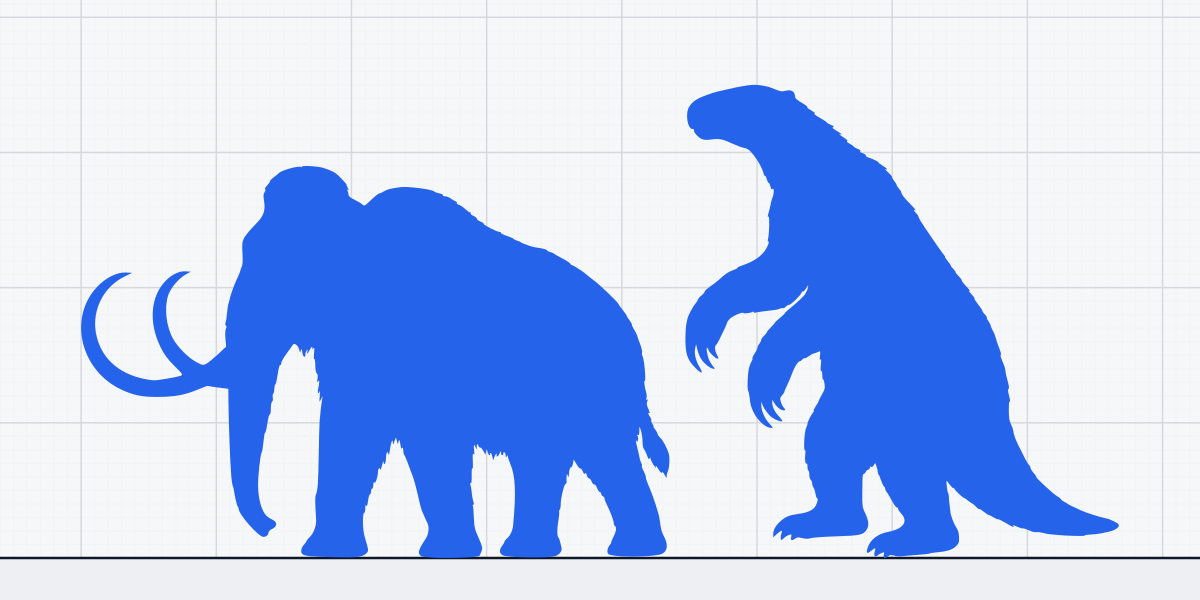
Megatherium, a giant ground sloth, gives the proposed disperser a vivid scale. It stood about 3.5 m (11 ft) tall and could rear on its hind legs, supporting its body with its tail and limbs while feeding. It belongs to the ground sloths, part of the wider group known as Ice Age megafauna. Its height and feeding posture show the scale of a possible disperser, not its diet.
The American mastodon offers another example of a large extinct mammal. It reached about 2.9 m (9.5 ft) at the shoulder. Its molars had pointed cusps suited to browsing on branches, leaves and other coarse vegetation. Those teeth help describe how mastodons fed, without identifying avocado as part of their diet.
What evidence could settle the animal hypothesis?
A strong link between an extinct mammal and avocado dispersal would need more than a large animal beside a large fruit. Researchers would look for identifiable avocado remains in fossilized dung, or other direct evidence that an animal ate the fruit. Seed survival matters too: if digestion destroyed the seed, the animal could not have dispersed it as a viable seedling’s starting point.
The Frontiers review of megafaunal seed dispersal (opens in a new tab) examines how hard it can be to infer extinct plant-and-animal relationships from fruit traits. It also considers other possible seed dispersers, a reminder that a large fruit does not by itself identify the animal that ate it.
No living animal in the avocado’s native range is known to perform the same whole-fruit transport job proposed for extinct giants (opens in a new tab). That absence gives the hypothesis an intriguing shape, but it does not name a past disperser. Seed reserves offer a possible benefit to a seedling after germination; a lost animal relationship would be a possible explanation for the fruit’s evolutionary history. Those ideas address different stages of the avocado’s story.
Humans also changed avocado size
The avocado’s present form has not been shaped by wild ecology alone. The PNAS report on avocado domestication (opens in a new tab) describes archaeological evidence from El Gigante Rockshelter in Honduras that avocado seed size and fruit traits increased through human management and domestication. Human hands also changed the dimensions of the fruit and its seed.
Related sizes
Things this article is about, with their sizes.
Sources
- Frontiers in Ecology and Evolution: Multiple External Seed Dispersers Challenge the Megafaunal Syndrome Anachronism and the Surrogate Ecological Function of Livestock (opens in a new tab) frontiersin.org
- Proceedings of the National Academy of Sciences (via PubMed Central): Early evidence of avocado domestication from El Gigante Rockshelter, Honduras (opens in a new tab) pmc.ncbi.nlm.nih.gov
- Encyclopaedia Britannica — Avocado; USDA FoodData Central — Avocados, raw, all commercial varieties
- Smithsonian National Museum of Natural History — Giant ground sloth; Encyclopaedia Britannica — Megatherium
- Encyclopaedia Britannica, “Pomegranate”; USDA FoodData Central, “Pomegranates, raw”
- Encyclopaedia Britannica, “Grapefruit”; USDA FoodData Central, “Grapefruit, raw”
- American Museum of Natural History — Mastodons; National Park Service — Mastodons
- CSIRO / Australian Tropical Rainforest Plants — Persea americana (opens in a new tab) apps.lucidcentral.org
- Smithsonian Magazine — Why the Avocado Should Have Gone the Way of the Dodo (opens in a new tab) smithsonianmag.com