 English
 العربية
 Deutsch
 Español
 Français
 हिन्दी
 Bahasa Indonesia
 Italiano
 日本語
日本語 한국어
한국어 Polski
 Português (Brasil)
 Русский
 Türkçe
 Українська
 简体中文
简体中文Learn
Why can’t insects grow to human size?
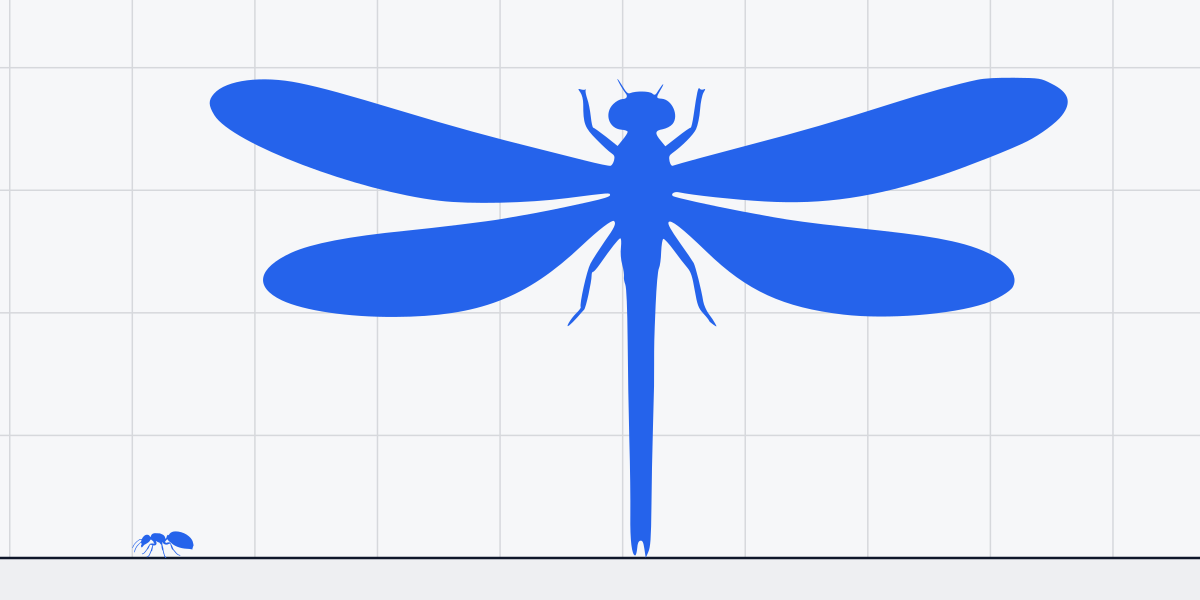
Insects cannot readily grow to human size because their branching air tubes struggle to supply oxygen as their bodies get larger. The fossil Meganeura monyi had a wingspan of 70 cm (2.3 ft), about 2.3 times the length of a standard 30 cm ruler.
Prehistoric giants were still not human-sized insects
Meganeura was a flying insect related to modern dragonflies. Its wingspan shows how far its wings reached, not the length of its body. The Natural History Museum’s account of giant dragonflies (opens in a new tab) describes this Carboniferous insect, which lived when atmospheric oxygen levels were unusually high.
Titanomyrma giganteum gives a different picture of ancient insect size. Its queen’s body measured 5 cm (2 in) long, about 8.3 times the length of a long grain of rice. That is a body measurement, unlike Meganeura’s wingspan, so the two fossils show different dimensions rather than matching examples of body length.
Another prehistoric arthropod, Arthropleura armata, reached 2.6 m (8.5 ft) from head to tail, about 1.3 times the height of a standard doorway. Arthropleura was a giant millipede relative, not an insect. It shows how large a prehistoric arthropod could grow, but it cannot be counted as a human-sized insect.
An insect’s air supply runs through branching tubes
An insect’s air-tube breathing system starts at openings along its body. These openings connect to branching tubes called tracheae, which split into finer passages that bring air close to tissues. Unlike a mammal, an insect does not rely on lungs and blood to carry oxygen around the body; the tracheal network carries air inward from the body surface.
At the finest ends of the network, oxygen moves into cells by diffusion. Molecules spread from places where they are more concentrated toward places where they are less concentrated. The small branches bring air near muscles and organs, so oxygen does not have to travel from a central lung across the whole body.
The system is not always passive. Some insects move their abdomens or use muscle movements to ventilate parts of the tracheal network, pushing air through it. Meganeura’s fossil remains cannot show exactly how it ventilated, but its wings belonged to an insect using this basic tube-based system. Active ventilation can move air through passages; it does not remove the challenge of delivering oxygen to tissue deep inside a larger body.
As a body grows, oxygen delivery loses ground
Imagine enlarging an insect while keeping the same basic plan: air still enters through openings on the outside, then follows branching routes toward the tissues. The farther a tissue lies from an opening, the longer oxygen must travel. Diffusion becomes slower over longer routes, while the larger body contains more tissue that consumes oxygen.
This matters especially for active muscles. Flight muscles need oxygen to release energy, and a flying insect must supply them while they work. A finer network of branches can bring air closer to those muscles, but the network has to fit inside the body and connect back to its openings. It cannot make the distance between the outer shell and every deeper tissue disappear.
Titanomyrma’s queen had a body length of 5 cm; a human-sized insect would need oxygen to reach much farther into its body. The comparison is not a claim that Titanomyrma marks a fixed maximum. It shows the kind of distance problem that grows with the body: deeper tissue needs a reliable supply even as the route from the exterior gets longer.
Oxygen could raise the ceiling, but other constraints remain
Meganeura lived during the Carboniferous, when atmospheric oxygen levels were unusually high. More oxygen in the surrounding air could have helped a tracheal system supply a large insect. The study of atmospheric oxygen and insect body size (opens in a new tab) examines that connection. Higher oxygen is one proposed contributor to prehistoric insect size, not a complete explanation on its own.
Arthropleura also lived in Carboniferous forests, but it belonged to a different arthropod lineage. Its length cannot show that insects reached the same size. The Museum Wales account of Arthropleura (opens in a new tab) discusses oxygen transport in arthropods alongside the structural demands of a large exoskeleton. More oxygen could ease the tracheal system’s workload, but the exoskeleton still had to support the animal.
A larger insect would need its respiratory network to serve tissue farther from the body surface, and its external skeleton would have to support a heavier body. Growth also involves molting: an insect must replace its rigid outer shell as it grows, rather than simply stretching it like skin. Stronger muscles alone would not solve any of these problems if those muscles could not get the oxygen they use.
These are constraints on insect size, not a proven absolute maximum. A human-sized insect would need more than oversized legs; its body plan would have to manage oxygen supply, support and growth together. Beneath an insect’s shell, branching tracheae taper toward the tissues, like a tree’s smallest limbs reaching into the spaces where its living cells need air.
Related sizes
Things this article is about, with their sizes.
Sources
- Natural History Museum: Griffinflies: The earliest flying insects (opens in a new tab) nhm.ac.uk
- Proceedings of the Royal Society B: Atmospheric oxygen level and the evolution of insect body size (opens in a new tab) pmc.ncbi.nlm.nih.gov
- Amgueddfa Cymru – Museum Wales: Arthur the Arthropleura (opens in a new tab) museum.wales
- Natural History Museum: The world's largest arthropod was a car-sized millipede (opens in a new tab) nhm.ac.uk
- Yale Peabody Museum, “Titanomyrma”; Royal Society, “Giant ants and ancient climate”