 English
 العربية
 Deutsch
 Español
 Français
 हिन्दी
 Bahasa Indonesia
 Italiano
 日本語
日本語 한국어
한국어 Polski
 Português (Brasil)
 Русский
 Türkçe
 Українська
 简体中文
简体中文Learn
What is the square-cube law?
The square-cube law says that if every length doubles, surface areas and load-bearing cross-sections grow fourfold, while volume grows eightfold. At unchanged density, weight also rises eightfold, so a geometrically similar design puts twice the load on each unit of supporting area.
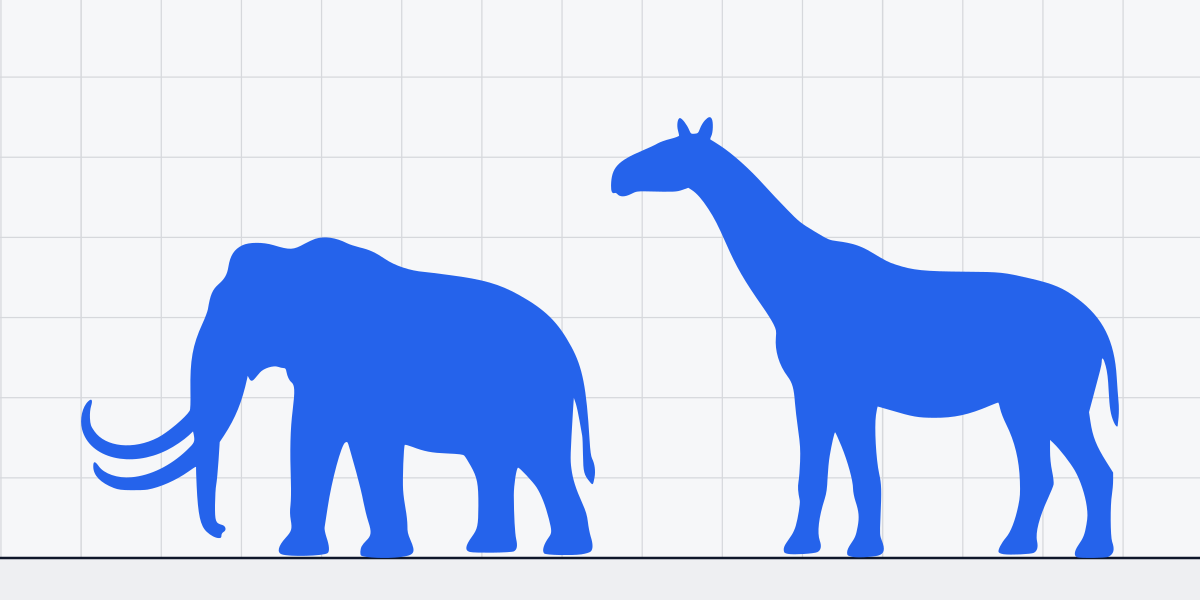
The Paraceratherium transouralicum stood just under 5 m (16 ft) at the shoulder, or about 2.5 doorway heights. The Natural History Museum’s account of Paraceratherium (opens in a new tab) describes a giant animal known from the fossil record. Doubling a model of its shape is a thought experiment, not a way to calculate the animal’s actual mass.
The multipliers hiding in a change of size
Call the scale factor k. Each length in a geometrically similar object is multiplied by k. A surface or a leg cross-section spans two directions (opens in a new tab), so its area changes by k². Volume extends in three directions, so it changes by k³. When k is two, those powers give four for area and eight for volume. The square and cube in the law are the powers applied to the change in length.
A bigger object does not get the same proportional increase everywhere. Its outer surfaces and supporting cross-sections grow with area; its mass grows with volume. At equal density, more volume means more mass and therefore more weight. In the Paraceratherium model, the legs’ supporting sections gain area, but the weight they must carry increases faster. The resulting increase in load per area is why the same proportions become a less comfortable fit as a design grows.
The straight-tusked elephant, Palaeoloxodon antiquus, stood 4 m (13 ft) at the shoulder and lived across Ice Age Europe. That is about twice the height of a standard doorway. Its measured shoulder height gives a real animal scale to compare with Paraceratherium, while the scaling exercise stays focused on what would happen to one shape if its dimensions changed.
Why the same support has a harder job
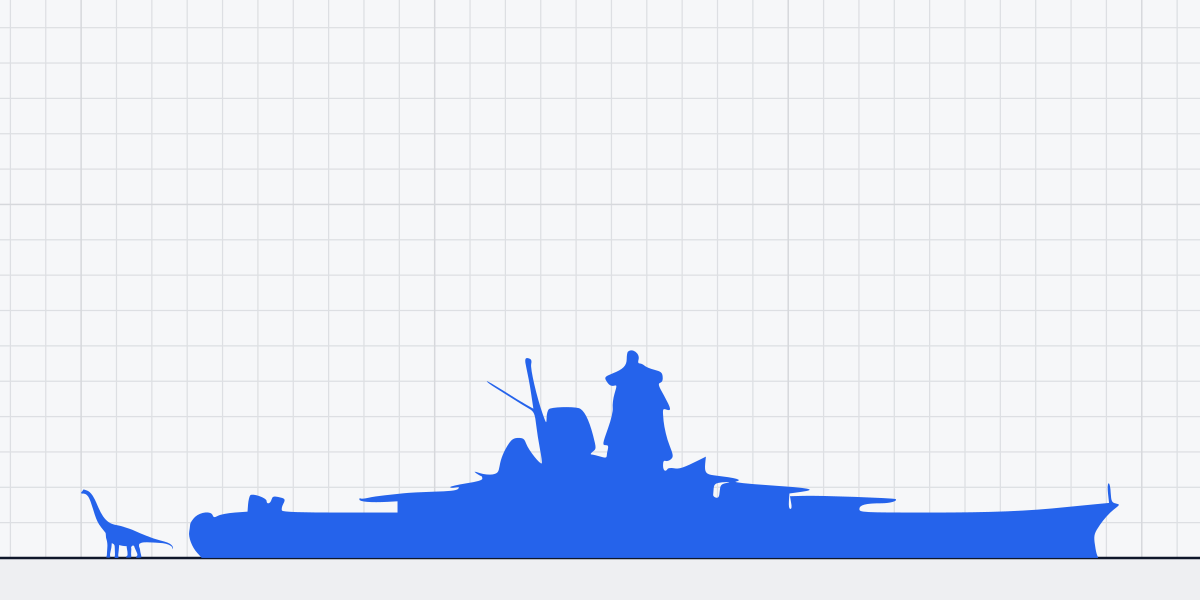
The Yamato-class battleship, a Japanese military vessel, measured 263 m (863 ft) in hull length and carried 46 cm main guns. Its hull was about 2.5 times the length of a football pitch. That comparison shows the scale of a real ship, but its length alone does not tell us how its frame handled stress.
Stress describes how much force is carried by a given area. Picture a roof beam enlarged uniformly to span a wider hall. The beam’s cross-section must carry the weight of the beam and roof, while the longer span changes how that load bends the structure. If every part grows in the same proportion, the cross-section gains area more slowly than the beam’s weight gains volume. The design cannot rely on its familiar proportions alone to preserve the same margin of support.
Engineers can respond by making the beam deeper or wider relative to its span, adding ribs, or placing columns to give the load another path to the ground. A deeper beam can resist bending more effectively; extra columns shorten the unsupported span but affect the space below. Stronger materials can help, too, though the beam still has to connect safely to the rest of the building. Each choice changes how forces move through the structure rather than simply making every part a larger copy.
A ship’s hull solves a different version of the problem. The hull and internal frame distribute forces through a large structure, and the vessel also interacts with the water supporting it. The University of Houston’s engineering explanation of size scaling (opens in a new tab) discusses why designers cannot assume that an enlarged object will perform like its smaller counterpart. Yamato’s long hull is a reminder that a real ship needs a frame and layout designed for its loads, not a miniature blueprint stretched to full size.
What the law pressures living bodies to change
The prehistoric mammals Paraceratherium and Palaeoloxodon had shoulder heights of just under 5 m and 4 m, respectively. Paraceratherium reached about 2.5 doorway heights. Those measurements make their size visible, but shoulder height does not tell us their mass or reveal how much force any particular bone carried.
The titanosaur Dreadnoughtus schrani had an estimated body length of 26 m (85 ft), about 2.2 city buses. It is known from an unusually complete skeleton found in Argentina, and the Natural History Museum’s Dreadnoughtus account (opens in a new tab) describes it as a gigantic titanosaur. The skeleton supports an estimate of body length; the square-cube law cannot turn that length by itself into a mass figure.
A living animal is not a small animal enlarged evenly. Bone shape, muscle, posture and the distribution of mass all affect how the body’s weight reaches the ground. A thicker limb or a changed stance alters the support system; those are possible responses to the pressure of size, not a formula for reconstructing the anatomy of Paraceratherium or Dreadnoughtus from a single measurement. The law helps identify the problem that a growing body must meet, while the fossil skeletons preserve evidence of the animals that existed.
The same geometry matters at a much smaller scale. The bacterium Deinococcus radiodurans, in the Micro World, measures 2 µm across; a red blood cell is 7.5 µm across, about 3.8 times that diameter. For cells, the balance between volume and surface area affects how material enters and leaves. The American Naturalist review of surface-area scaling in cells and organisms (opens in a new tab) examines how living systems deal with those constraints. A cell and a giant mammal face different practical problems, but both are shaped by the relationship between area and volume.
Why the law is a pressure, not a stop sign
The square-cube law describes uniform scaling, not a rule that every real object must keep its original proportions. A roof beam can grow deeper relative to its span, and a ship can use a frame that directs forces through more than its outer shell. In a large mammal, bones, muscles and posture form a support system rather than a stack of identical enlarged parts. The altered design may still work; it simply is not a scaled copy.
Material and task also matter. A hollow beam and a solid beam can have the same outer dimensions but different weights. A structure supporting its own mass faces a different job from one also bearing a roof, cargo or people. A vessel supported by water meets different demands from a mammal standing on land. These differences explain why the Yamato’s hull and a giant animal’s limbs cannot be designed by the same blueprint, even though the same geometric scaling relationship applies to both.
The law is useful because it points engineers and biologists toward the question a simple enlargement hides: which part carries the load, and how does that part change as the whole grows? For a building, the answer may involve beam depth, braces or columns. For an animal, it lies in the combined shape and arrangement of the structures that support its body. The geometry reveals the pressure; the particular design shows the response.
A scaling check for a new design
For a proposed pump, roof beam or model animal, start by marking the parts that carry weight. Then look at their cross-sections and ask how those areas would change if the overall design grew. Separately, consider how the volume—and, at unchanged density, the weight—would change. Keeping those questions apart prevents a longer beam or taller model from seeming like a complete measure of the job its supports must do.
Next, inspect where the load travels. A beam may need more depth, a building may need another column, and a large body may need a different distribution of support. The useful instinct is not to stretch every part of the drawing by the same amount, but to look at the supporting shape beside the weight it must carry. If a roof beam had to span a wider hall, would you deepen it, add a column beneath it, or change the material before the roof pressed down?
Related sizes
Things this article is about, with their sizes.
Sources
- Natural History Museum, London: Why were dinosaurs so big? The secrets of titanosaurs' super size (opens in a new tab) nhm.ac.uk
- University of Houston, College of Engineering: A Matter of Size (opens in a new tab) engines.egr.uh.edu
- Natural History Museum, London: Dreadnoughtus (opens in a new tab) nhm.ac.uk
- The American Naturalist / University of Chicago Press: General Models for the Spectra of Surface Area Scaling Strategies of Cells and Organisms: Fractality, Geometric Dissim ilitude, and Internalizati (opens in a new tab) journals.uchicago.edu
- Naval History and Heritage Command, Yamato class
- Thurrock Council: The Aveley mammoth (opens in a new tab) thurrock.gov.uk
- ASM Journals: Deinococcus radiodurans review; NCBI: Deinococcus genome