 English
 العربية
 Deutsch
 Español
 Français
 हिन्दी
 Bahasa Indonesia
 Italiano
 日本語
日本語 한국어
한국어 Polski
 Português (Brasil)
 Русский
 Türkçe
 Українська
 简体中文
简体中文Learn
How many grapes does it take to make a bottle of wine?
A standard 750 ml (opens in a new tab) bottle of wine takes roughly 600–800 (opens in a new tab) grapes, with about 700 as a central estimate. That count comes from weighing whole fruit and estimating how much finished wine its juice produces, not from imagining berries packed inside a glass bottle.
Start with the bottle, not the grapes
The target is finished wine: a 750 ml bottle after fermentation and clarification. A commercial-scale conversion (about 150 gallons of wine per ton of grapes) works out to roughly 1.2 kg of grapes for one bottle (opens in a new tab); home-winemaking guidance puts the figure a bit higher, at about 1.5 kg (opens in a new tab). This article works from about 1.2 kg as a central estimate. This yield estimate accounts for liquid left among the skins and other solids, as well as wine separated from sediment before bottling.
Pressing turns clusters into liquid and a mass of skins, seeds and pulp. Some juice stays caught in that wet material instead of flowing into the tank. The order of pressing and fermentation varies by wine style: red grapes may ferment with their skins before pressing, while many white wines are pressed earlier. So the press does not deliver the same amount of usable liquid from every batch.
Fresh juice also is not the finished drink. Yeast ferments the grape sugars, and suspended particles settle out as the wine rests. Winemakers can then draw the clearer wine away from the sediment. Each step can leave some liquid behind; a yield expressed as finished wine per kilogram of grapes rolls those losses into a single estimate.
Give each grape a place on the scale
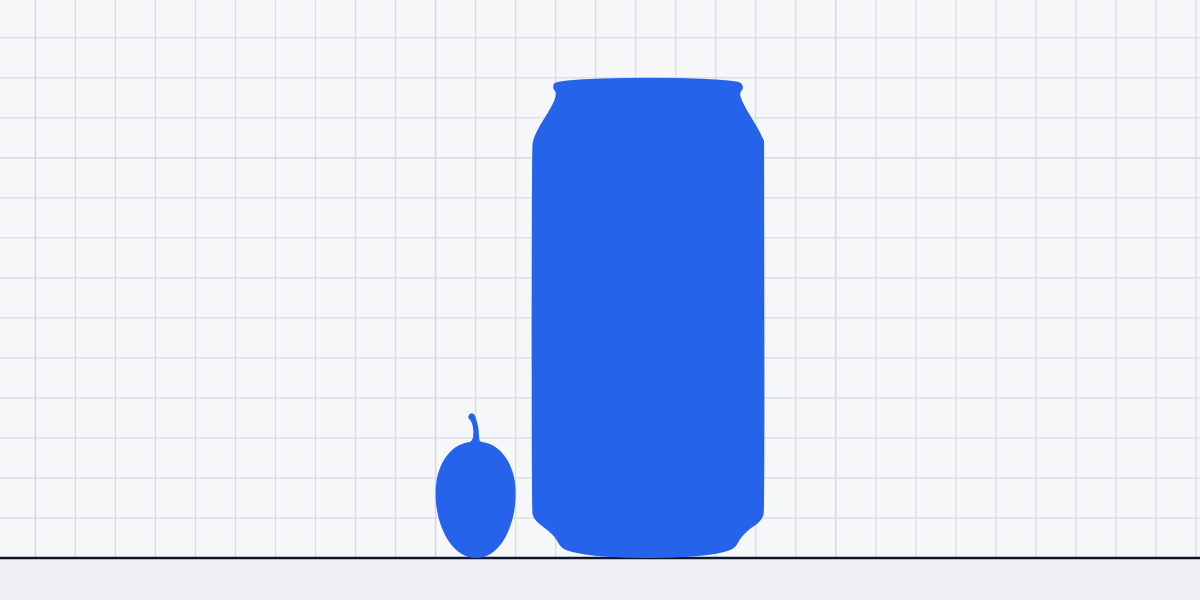
A typical table grape is about 2 cm wide, roughly 3.3 times the length of a grain of rice. Botanically, a grape is a berry. That measured width helps picture the fruit, but it cannot tell you how much a wine grape weighs.
A standard soda can stands 12 cm tall, putting the grape’s width in view against a familiar object. The comparison is about size, not mass: a table grape and a wine grape may differ in size, and two berries from the same bunch need not weigh exactly the same.
For the arithmetic, use an estimated average of about 1.5 g per wine grape (opens in a new tab). The 2 cm table grape is a visual reference; the assumed mass belongs to a wine grape, not to every grape of that width. Grapes vary with variety and growing conditions, so this average stands in for a mixed harvest rather than describing every berry.
That variation changes the count in a direct way. If the same kilogram of fruit is made up of smaller berries, it contains more individual grapes; heavier berries mean fewer. A bunch is not a row of identical beads, so using an average berry mass keeps the estimate useful without pretending each grape has been weighed.
Turn kilograms of fruit into a grape count
The central fruit estimate is about 1.2 kg, or 1,200 g. Divide that by the estimated 1.5 g per wine grape and the result is roughly 800 grapes. The units matter: grams of whole fruit divided by grams per whole berry gives a berry count.
You can follow the conversion with estimation tips: change kilograms into grams, then divide by the mass of one grape. The kilogram figure describes grapes before pressing; the 1.5 g figure describes the mass of an individual grape, not the juice that reaches the fermentation tank. Comparing bottle volume directly with the size of an intact berry would skip both pressing and the material left behind.
The calculation gives a sensible middle, not a tally that a winemaker could apply to every bottle. A harvest with lighter berries has a different count per kilogram, while a batch that yields less finished wine needs more fruit to fill the same bottle. Those two moving parts are why a range is more honest than a precise berry total.
Why the count changes from harvest to harvest
Pressing is a winemaking choice as well as a way to extract juice. A gentle press leaves more liquid in the skins and pulp; pressing harder can draw out more material from the skins and seeds, affecting the wine’s taste. The winemaker balances how much liquid to collect against the style of wine being made.
The fruit itself changes that balance. A ripe, juicy grape does not behave exactly like a smaller or firmer one, and the winery’s handling of the crop affects what reaches fermentation and bottling. The calculation uses a finished-wine yield to cover those differences, rather than treating every grape as a tiny container that empties completely.
A bottle, then, does not represent a fixed count of berries in the way a carton might hold a fixed number of objects. It represents a share of a harvest transformed by pressing, fermentation and settling. At the press, round grapes give way to a damp mat of skins and seeds beside a stream of juice; the wine in the bottle is what that fruit becomes.
Related sizes
Things this article is about, with their sizes.
Sources
- University of Arkansas System Division of Agriculture Cooperative Extension Service: Crush It Arkansas! Winemaking (opens in a new tab) uaex.uada.edu
- Can Manufacturers Institute, “The Can”; U.S. FDA, “Beverages”
- TTB (Alcohol and Tobacco Tax and Trade Bureau): Wine Labeling — Net Contents (authorized standards of fill, incl. 750 mL) (opens in a new tab) ttb.gov
- Cornell University CALS, Chris Gerling: Grapes 101 — How many grapes in a bottle of wine? (opens in a new tab) cals.cornell.edu
- Michigan State University Extension: Predicting Harvest Yield in Juice and Wine Grape Vineyards (E3186) (opens in a new tab) canr.msu.edu