
 English
 العربية
 Deutsch
 Español
 Français
 हिन्दी
 Bahasa Indonesia
 Italiano
 日本語
日本語 한국어
한국어 Polski
 Português (Brasil)
 Русский
 Türkçe
 Українська
 简体中文
简体中文Micro World
How big are microscopic things? 85 sizes compared
The largest thing on this page is about 15 million times the size of the smallest. A carbon atom is about 0.34 nm across, while a colony of the cyanobacterium Nostoc is about 5 mm (0.2 in) wide, big enough to see without a microscope. Between them are sugar and chlorophyll molecules, viruses such as the giant Mimivirus at about 750 nm, bacteria, spores, pollen grains and human cells. A human B lymphocyte, one of the white blood cells, is about 7 µm across, and the giant amoeba Chaos carolinense stretches to about 1 mm. Sizes this small are hard to picture, so the drawing below zooms out in steps and marks how far each step zooms. Every size is for one typical example, as its source measures it.
Free on iPhone and Android


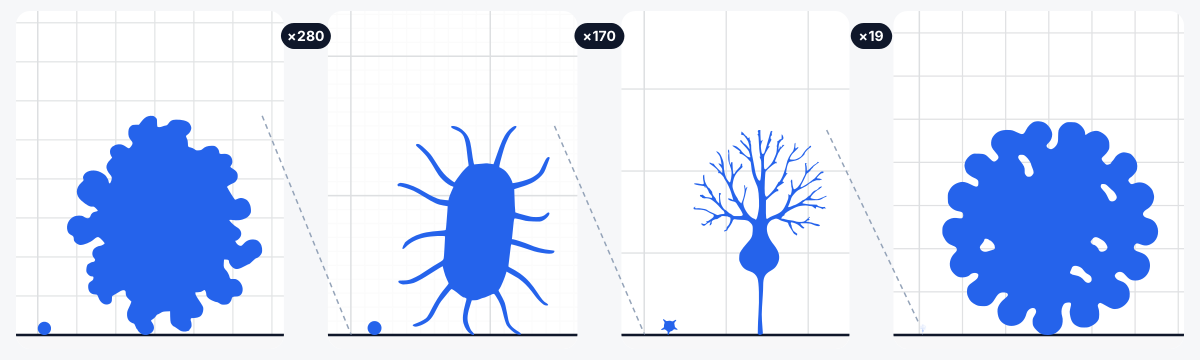
Sizes in Micro World
All 85 microscopic things on this page, from the smallest to the largest. Each size is in metric units first, with imperial in brackets where it differs.
Free on iPhone and Android
Play Micro World in Magnitudle
5 levels of Micro World in the app: 5 hard.
Levels include “Cells and Viruses Unseen”, “Tiny Particles Tiny Life” and “Hidden World Showdown”.
In each level you guess sizes before you see them: resize a silhouette to scale, rank things by size or pick the biggest.
Levels, the daily challenge and live duels are all in the app: Magnitudle for iPhone.
Test your sense of scale
Tap the biggest one