 English
 العربية
 Deutsch
 Español
 Français
 हिन्दी
 Bahasa Indonesia
 Italiano
 日本語
日本語 한국어
한국어 Polski
 Português (Brasil)
 Русский
 Türkçe
 Українська
 简体中文
简体中文Learn
How many seeds are in a pomegranate—and is 613 real?
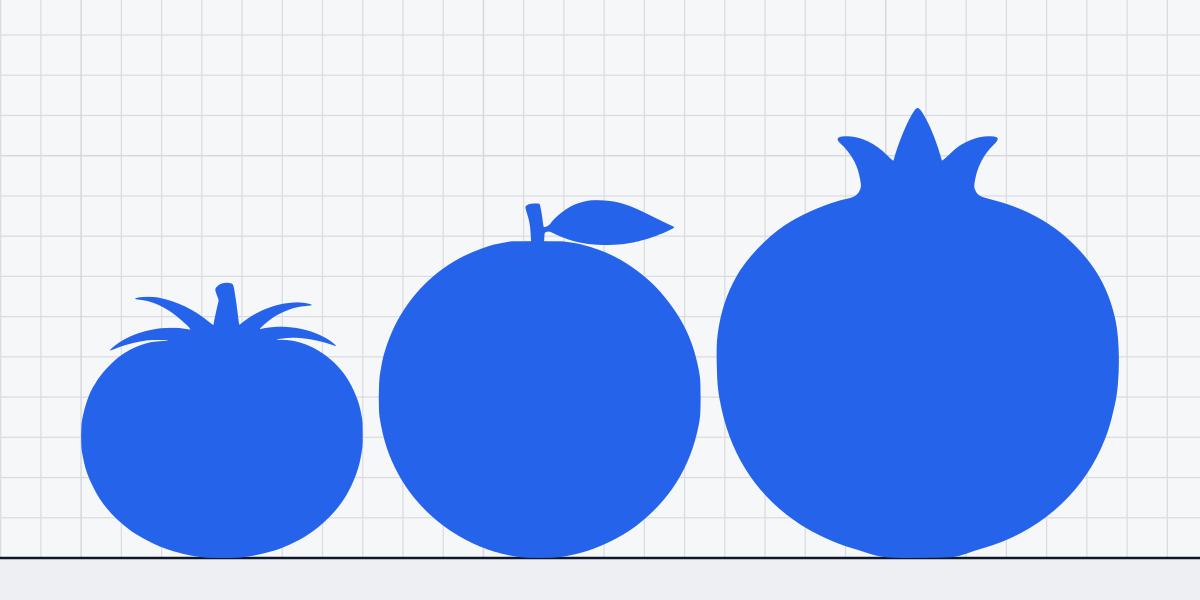
A pomegranate is not guaranteed to have exactly 613 seeds; counts can range from a few hundred to well over a thousand (opens in a new tab). A typical whole pomegranate is about 10 cm (3.9 in) wide.
Why the 613-seed figure appears
The 613-seed claim connects the fruit with the 613 commandments counted in Jewish tradition (opens in a new tab). A Jewish Action discussion of the seed claim (opens in a new tab) describes that association. It gives the number a memorable meaning, but not a biological rule for the fruit in your hand.
Inside the leathery rind are hundreds of juicy coverings called arils. The University of Florida’s pomegranate guide (opens in a new tab) explains that the edible arils contain the seeds. At 10 cm wide, a pomegranate spans about 4.2 large coins.
What counts as a pomegranate seed?
The red, juicy pieces are arils; the seed sits inside the fleshy covering. In everyday conversation, people often call the arils “seeds.” A strict seed count means tallying the seeds themselves, not treating every visible red piece as a seed. The University of Florida’s extension guide (opens in a new tab) describes the fruit’s numerous seeds surrounded by edible, juicy pulp called arils.
That distinction matters when people compare counts. An aril tally records the edible pieces, while a seed tally records what is inside them. Label your tally before you start, and keep the same unit from the first piece to the last. If you count arils for a kitchen recipe, call the result an aril count rather than a seed count.
Pomegranates belong among fruits and nuts, but their edible parts are arranged differently from the familiar flesh of an orange. The arils sit in chambers separated by pale membranes. Those natural divisions give you a practical way to take a sample without mixing up the fruit’s outer rind, the juicy coverings, and the seeds inside.
How to estimate the seed count
For a seed estimate, open the fruit and remove the arils from a chamber. Separate the seeds from the arils in that sample and tally the seeds themselves. Then compare the sample with the fruit’s full aril pile: estimate what share of the total arils came from the sampled area, and scale the seed tally to match that share. The estimation tips follow the same useful pattern: count a manageable sample, then extend it to the whole.
A chamber may be more or less full than the surrounding parts, so avoid treating its size alone as a perfect guide. Spread the arils from the sample beside the remaining arils, then judge the sample’s share of the pile. If the arils are spread unevenly, sample sections from different parts of the fruit. A sample gathered across the fruit gives a more representative picture than a particularly full pocket.
Keep the tally and the estimate attached to the same unit. If you counted seeds in the sample, estimate the total seeds; if you counted arils, estimate the total arils. Don’t convert an aril tally into a seed total without checking the seeds inside. For a direct total rather than an estimate, separate and count the seeds in all the arils, keeping them together in a bowl so none get mixed back into the uncounted fruit.
The fruit’s outside gives a sense of its scale, not a count. A whole orange is about 8 cm (3.1 in) across, while a medium tomato is about 7 cm (2.8 in) across. Their sizes put the pomegranate in context, but the seeds become countable only after you open it.
How fruit size helps predict the count
A larger pomegranate generally has more room for arils (opens in a new tab), so its size is a better starting clue than a fixed figure such as 613. That is a broad guide, not a formula for turning width into a seed total. The fruit’s chambers, the fullness of its arils, and the seeds inside them all matter to the final count.
The University of Georgia’s pomegranate production guide (opens in a new tab) covers how the fruit is grown. Variety and growing conditions influence the fruit that develops, so a size-based estimate is most useful when you compare fruit of a similar size and use the same counting unit. A larger fruit can suggest a higher count; opening and sampling it makes the estimate specific to that pomegranate.
Use 613 as a memorable starting guess, not a target every fruit must reach. Sample the arils, count the seeds inside them, and scale that tally to the portion you sampled. The bowl of seeds from the fruit in your hand gives you a more useful estimate than the legend.
Related sizes
Things this article is about, with their sizes.
Sources
- Jewish Action: What’s the Truth about . . . Pomegranate Seeds? (opens in a new tab) jewishaction.com
- University of Florida IFAS Gardening Solutions: Pomegranates (opens in a new tab) gardeningsolutions.ifas.ufl.edu
- University of Florida IFAS Extension: HS44/MG056: The Pomegranate (opens in a new tab) ask.ifas.ufl.edu
- University of Georgia Cooperative Extension: Pomegranate Production (opens in a new tab) fieldreport.caes.uga.edu
- Encyclopaedia Britannica, “Pomegranate”; USDA FoodData Central, “Pomegranates, raw”
- Encyclopaedia Britannica — Tomato; USDA FoodData Central — Tomatoes, red, ripe, raw
- Encyclopaedia Britannica — Orange; USDA FoodData Central — Oranges, raw
- Chabad.org: The 613 Commandments (Mitzvot) (opens in a new tab) chabad.org
- HortScience (American Society for Horticultural Science): Wetzstein, Zhang, Ravid & Wetzstein, “Characterization of Attributes Related to Fruit Size in Pomegranate,” HortScience 46(6):908–912 (2011) (opens in a new tab) journals.ashs.org