 English
 العربية
 Deutsch
 Español
 Français
 हिन्दी
 Bahasa Indonesia
 Italiano
 日本語
日本語 한국어
한국어 Polski
 Português (Brasil)
 Русский
 Türkçe
 Українська
 简体中文
简体中文Learn
How big is an acre, really?
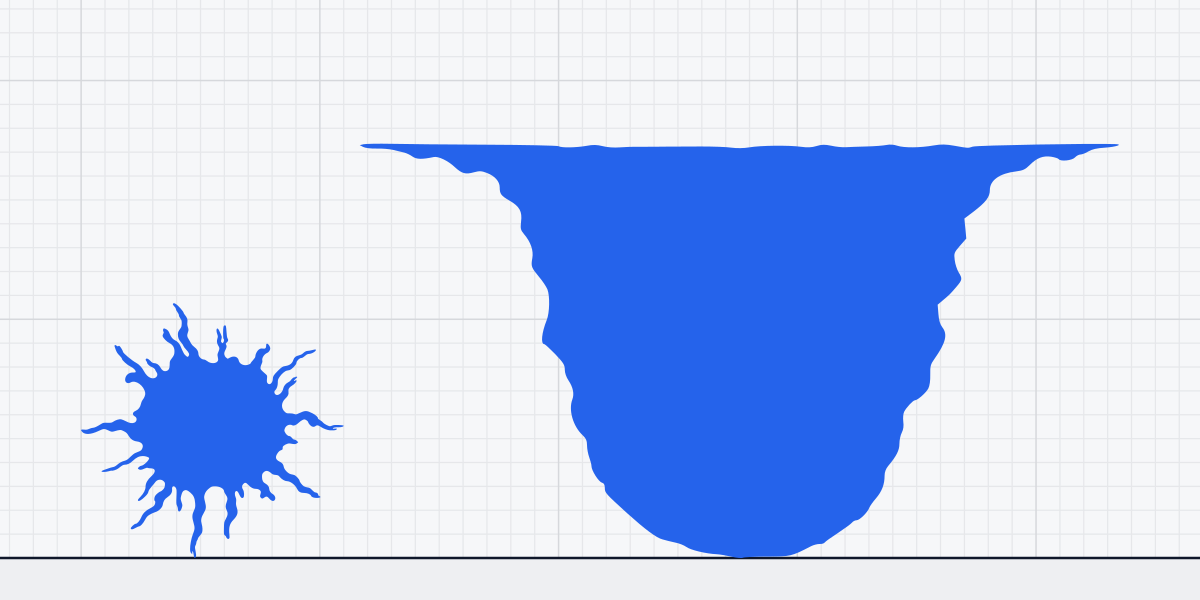
An acre is about 4,047 square metres (43,560 square feet). On the ground, that is roughly three-quarters of an American football field (opens in a new tab).
The Great Blue Hole is a nearly circular marine sinkhole formed during past ice ages, with a surface diameter of 318 m (1,040 ft). Its measured width gives us a way to turn a circle into an estimated area.
From an ox-team's day to a fixed area
The acre is traditionally linked to the area a team of oxen could plough in a day (opens in a new tab). Picture oxen pulling a plough through a field, cutting a long strip; the day's work gives the unit its old, practical image. The ground covered depended on the team, the plough and the field, so that image is about the unit's history, not its modern definition.
Today an acre is a fixed area, no matter whether it lies under crops, a garden or a roadside verge. The University of Georgia Cooperative Extension defines an acre (opens in a new tab) as 43,560 square feet, or about 4,047 square metres. The boundary can change shape, but the area does not.
A square acre would have sides about 63.6 m (209 ft) long. That straight edge is close to the 70.6 m length of a Boeing 747-400. But land parcels are not always square: the traditional acre can also be pictured as a rectangle 66 ft by 660 ft (opens in a new tab), about 20 m by 201 m. A property line might follow a long field edge or bend along a road, making the same acre look very different on a map.
How an acre compares with a hectare
A hectare is 10,000 square metres (opens in a new tab), or about 2.47 acres. Drawn as a square, it has 100 m sides. Each 100 m side is just short of the 105 m length recommended for a full international pitch (the Laws of the Game (opens in a new tab) set the range at 100-110 m). That gives the hectare a clear ground-level scale, while the acre is a little under half that area.
The distinction matters on maps and property listings: an acre and a hectare describe area, not a length from one boundary to another. A square plot and a narrow strip can each be one acre, just as the rectangle described above has the same area as a square acre. The shape changes what fits on the land; it does not change the unit.
Turn a diameter into acres
A diameter is the straight line across a circle through its centre. To estimate the area, halve the diameter to get the radius, then multiply the radius by itself and by pi. This works because a circle spreads outward from its centre in every direction; its area depends on the radius squared, not just on the distance across.
The Grand Prismatic Spring measures 110 m (361 ft) across at its widest point. Treat that span as the diameter of a circle and the radius is 55 m. Multiplying the radius by itself and by pi gives an estimated footprint of about 9,500 square metres, or roughly 2.35 acres. That is just under a hectare.
Grand Prismatic Spring spans about 4.6 tennis-court lengths at its widest point. Its vivid rings come from heat-loving microbes living at different temperatures. Since its measured width is the widest point, not a traced outline, the circle calculation is an estimate of its footprint rather than a surveyed area.
A wider circle covers much more ground
At 318 m across, the Great Blue Hole is about three times the 105 m length of a football pitch. To estimate its area, halve that diameter for a radius of 159 m, then apply the circle formula. The result is about 79,000 square metres, nearly 20 acres, or about 8 hectares.
Together, the two Nature features show how a modest-looking difference in width can have a much bigger effect on area. The Blue Hole is about 2.9 times as wide as Grand Prismatic Spring; its estimated circular footprint is nearly 20 acres, compared with about 2.35 acres for the spring. The Blue Hole's nearly circular surface makes the estimate useful, though it is not a surveyed land boundary.
For circles, doubling the diameter makes the area four times larger.
Related sizes
Things this article is about, with their sizes.
Sources
- Encyclopaedia Britannica: Acre (unit of measurement) (opens in a new tab) britannica.com
- University of Georgia Cooperative Extension: Common Agricultural Calculations Using Unit Conversions (opens in a new tab) fieldreport.caes.uga.edu
- Encyclopaedia Britannica: Hectare (opens in a new tab) britannica.com
- IFAB (International Football Association Board): Laws of the Game, Law 1 - The Field of Play (opens in a new tab) theifab.com
- Wikipedia: American football field (opens in a new tab) en.wikipedia.org
- UNESCO World Heritage Centre, Belize Barrier Reef Reserve System; National Geographic, Great Blue Hole
- National Park Service — Grand Prismatic Spring; USGS — Yellowstone's Hydrothermal Features