 English
 العربية
 Deutsch
 Español
 Français
 हिन्दी
 Bahasa Indonesia
 Italiano
 日本語
日本語 한국어
한국어 Polski
 Português (Brasil)
 Русский
 Türkçe
 Українська
 简体中文
简体中文Learn
How far away is the horizon from a beach or mountaintop?
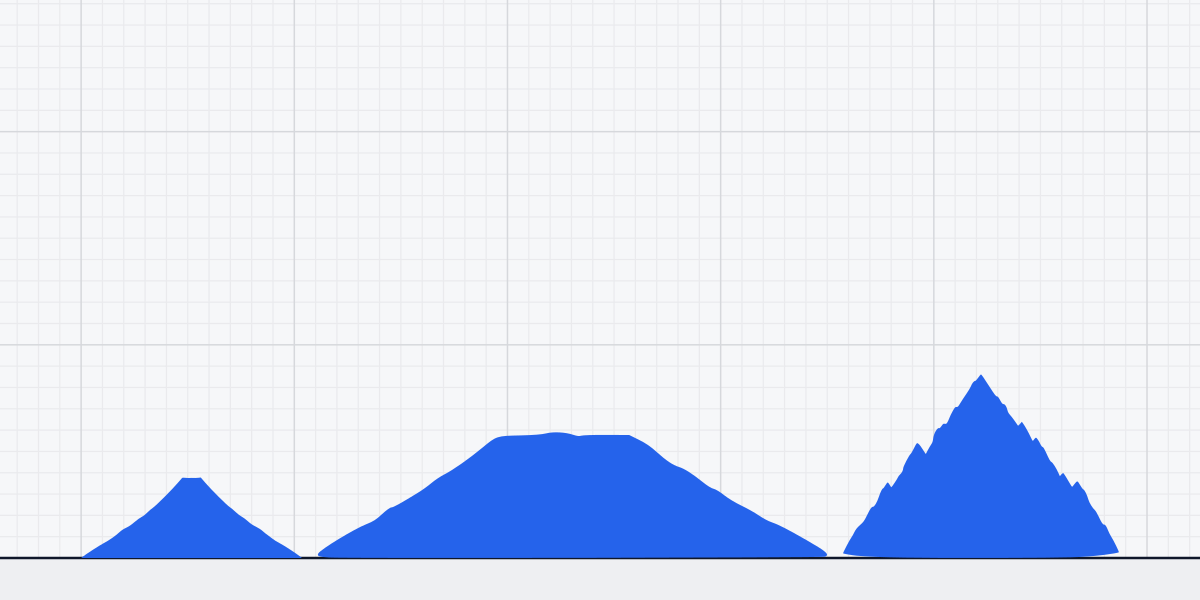
At standing eye level on a sandy beach, the geometric horizon is about 5 km away. From the summit of K2, it is about 330 km away.
What sets the distance to the horizon?
A standard approximation is d ≈ √(2Rh) (opens in a new tab), where d is the distance to the horizon, h is the observer’s height above the surface, and R is Earth’s radius, about 6,371 km. Keep R and h in the same units, and d comes out in those units. The relationship captures the geometry of a sightline reaching the curved surface, rather than passing through the ground.
Picture Earth as a circle on a page. Draw a dot above its edge for an observer, then draw a straight line that just touches the circle. That touch point is the geometric horizon. A line aimed lower meets the ground; a line aimed higher travels above it. On a beach, the line runs from your eyes across the water until the curve of the sea drops away beneath it.
For an observer about 2 m above a beach, NASA Goddard’s horizon-distance guide (opens in a new tab) gives a geometric horizon about 5 km away. That is a convenient standing-viewpoint estimate, not a measurement of every beachgoer’s eye height. An average adult stands 1.7 m (5.6 ft) tall, and their eyes are below the top of their head.
Why beach posture changes the view
The height that matters is how far your eyes sit above the surface. Crouch at the water’s edge and the horizon comes closer; climb a dune and it moves farther away. A person sitting on the sand and a person standing on the same beach do not look from the same height, even if they are only a short walk apart.
The horizon is a boundary in the view, not a line painted on the water. On a clear day, a distant ship can appear to sink as it travels away: its hull disappears behind the curve before its higher parts. Raising your viewpoint on a dune can bring more of the ship back into sight, because the sightline starts higher above the sea.
Why height does not multiply the distance
The square root in the formula slows the increase. Raise the viewing height to four times its starting value, and the horizon distance only doubles. NASA’s guide gives a useful intermediate scale: from a height of 1 km, the horizon is about 113 km away. A mountain summit adds kilometres of height, but it does not add the same number of kilometres to the horizon.
For the mountain estimates below, the listed summit elevation is used as the observer’s height over a smooth sea-level surface. This gives a consistent geometric comparison, not a map of sightlines across real mountain terrain.
Mount Fuji rises 3.78 km (2.35 mi) above sea level. Put that elevation into the formula and its geometric horizon is about 220 km away. Fuji is Japan’s tallest mountain, but the distance to its horizon is set by the curve of Earth as well as the height of its summit.
Mount Kilimanjaro reaches 5.89 km (3.66 mi) above sea level, according to the Smithsonian’s Global Volcanism Program entry (opens in a new tab). The same calculation puts its geometric horizon at about 275 km. Clouds or surrounding peaks can still interrupt a real view long before the distant edge of that geometric horizon.
K2 rises 8.61 km (5.35 mi) above sea level. Its height is about ten times the Burj Khalifa’s 828 m (2,720 ft). The comparison gives K2’s vertical scale: a summit can tower over a city landmark while its horizon remains a distance across a region, not a view across the whole planet. The highest mountains change the view by lifting the observer, while Earth’s curve still sets its reach.
Why the geometric horizon is not the whole view
The calculation tells you where a sightline meets a smooth Earth. It does not tell you whether you can pick out a landmark there. From a beach, an island’s low shore may disappear while a hill on the island remains visible. From a summit, a ridge can hide a valley even when the distant geometric horizon lies far beyond it. Terrain changes the view in ways the circle-and-line model leaves out.
Air changes it too. Haze reduces contrast, while fog and clouds can cover parts of the view. Atmospheric refraction bends light as it passes through layers of air, which can shift the apparent horizon. The San Diego State astronomy explanation (opens in a new tab) describes how refraction affects the distance. A mountain can have a wide geometric reach and still look out on a bank of cloud instead of distant land.
A useful distinction is between the horizon of the ground and the farthest object you can see. A high object rises above the ground’s sightline, so it may remain visible after the land beneath it has dropped out of view. That is why the question is not simply how far sight carries, but what is high enough to clear the curve.
A plane can hang beyond the ground horizon, its outline still visible against the sky after the sea below it has curved out of sight.
Related sizes
Things this article is about, with their sizes.
Sources
- NASA Goddard Space Flight Center: Distance to the Horizon (opens in a new tab) pwg.gsfc.nasa.gov
- Smithsonian Institution, National Museum of Natural History: Global Volcanism Program | Kilimanjaro (opens in a new tab) volcano.si.edu
- San Diego State University, Department of Astronomy: Distance to the Horizon (opens in a new tab) aty.sdsu.edu
- Japan Meteorological Agency, Mount Fuji; Encyclopaedia Britannica, Mount Fuji
- Encyclopaedia Britannica, K2; National Geographic, K2