 English
 العربية
 Deutsch
 Español
 Français
 हिन्दी
 Bahasa Indonesia
 Italiano
 日本語
日本語 한국어
한국어 Polski
 Português (Brasil)
 Русский
 Türkçe
 Українська
 简体中文
简体中文Learn
Why are eggs egg-shaped instead of round?
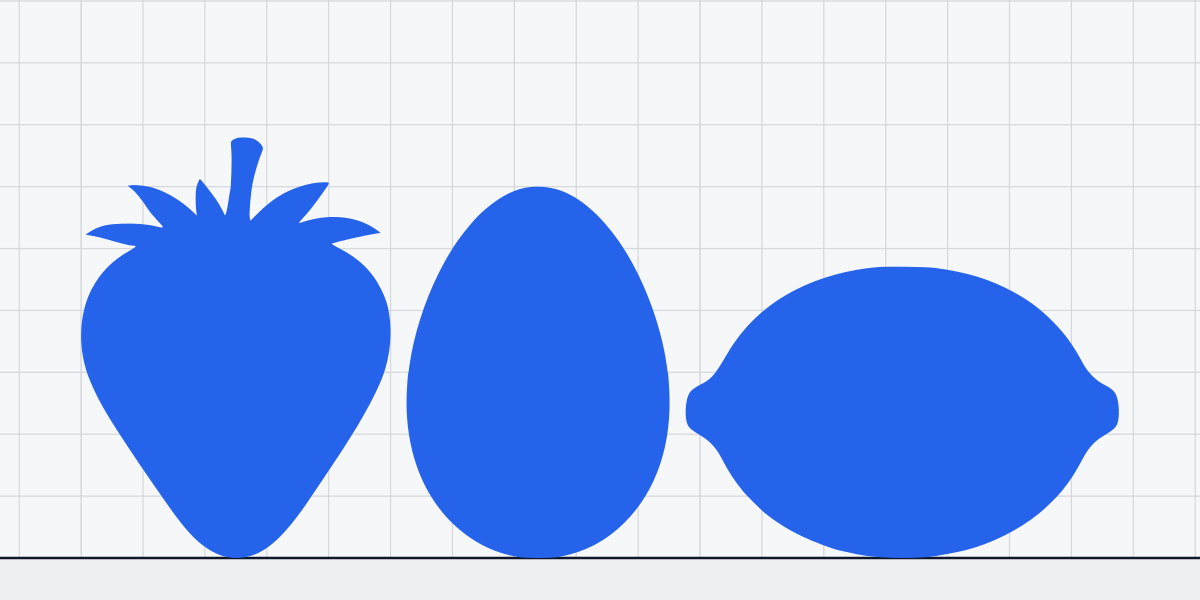
A chicken egg is about 6 cm (2.4 in) tall, roughly 2.5 times the diameter of a large coin. A narrow stretch of the hen’s oviduct called the isthmus is thought to restrict the soft egg mass (opens in a new tab) just enough to make the rest of it bulge outward on one side, creating its unequal outline: a broad end and a tapered end.
A strawberry is about 5 cm (2 in) wide, and a lemon is about 7 cm (2.8 in) long. Those fruits give the egg a familiar scale, but its outline is distinctive among everyday eggs and dairy: one end stays rounded while the other narrows.
Why isn't an egg a sphere?
Seen from the side, a chicken egg has a rounded end and a pointed end. A regular oval narrows in a similar way at both ends; an egg’s curve changes along its length, so turning it end for end changes its silhouette. That unevenness, not simply its stretched outline, is the feature the hen’s oviduct has to produce.
Follow the shell from the broad end toward the tip. Its curve tightens gradually, without a seam or a separate cap marking where the pointed part begins. The taper belongs to the whole outline, which is why “egg-shaped” means more than a sphere stretched into an oval.
How does an egg get its shape?
An egg does not leave the hen as a hard shell. A yolk enters the oviduct, and albumen and shell membranes are added as it travels. Farther along, the shell-forming part of the oviduct deposits the shell (opens in a new tab). These layers form in sequence around the developing egg; it is not pressed into a finished shape after laying.
While the shell is forming, the egg remains inside a flexible, muscular passage. The oviduct’s contractions move it along, and physical restriction against the soft layers in the narrower isthmus is thought to help shape (opens in a new tab) the outline before the shell hardens. The passage is not a rigid mold stamping out identical eggs: its moving walls act on the egg as it passes through.
The pointed end is therefore part of the egg’s overall contour, not a small feature added to an otherwise round shell. The hen’s oviduct supplies the movement and the restriction that shapes it; the shell takes on that uneven curve as it forms. By the time a breakfast egg reaches the carton, the shaping has already happened inside the hen.
Why does a pointed egg roll in a curve?
On a smooth board tilted toward an edge, release an intact egg with a sideways nudge. Instead of tracking straight downhill, it turns as it rolls, its pointed end tracing a curved path (opens in a new tab). The unequal ends change how the egg meets the board as it turns, steering its path around rather than sending it straight toward the edge.
The exact track depends on the surface and the direction of the nudge, so an egg is not guaranteed to circle neatly or stop short of a ledge. A rough nest floor or a different starting position can change the roll.
Does the rolling curve explain why eggs evolved this way?
A curved route could help keep an egg near the middle of a sloping nest instead of letting it roll straight toward the rim (opens in a new tab). That is a possible benefit of the shape, but watching a modern egg roll does not show that this benefit caused the shape to evolve.
An evolutionary explanation would need evidence connecting egg shape to survival and reproduction across generations. Researchers could compare related birds nesting on different surfaces (opens in a new tab), test whether egg shape changes how often eggs leave a nest or hatch, and look for inherited shape differences that track those outcomes. A successful roll on a smooth board alone cannot establish that link.
On a sloping nest floor, the pointed egg’s track curves back toward the shallow center, leaving the rim just beyond its path.
Related sizes
Things this article is about, with their sizes.
Sources
- USDA Food Safety and Inspection Service: Shell Eggs from Farm to Table (opens in a new tab) fsis.usda.gov
- Encyclopaedia Britannica, “Strawberry”; Royal Horticultural Society, “Strawberries”
- Encyclopaedia Britannica, “Lemon”; USDA, “Lemons”
- British Ornithologists' Union — The mysterious basis of egg shape in birds (C. Deeming) (opens in a new tab) bou.org.uk
- Ohio State University Extension (Ohioline) — The Making of an Egg (opens in a new tab) ohioline.osu.edu
- Journal of Experimental Biology — How the egg rolls: a morphological analysis of avian egg shape (opens in a new tab) journals.biologists.com
- Science News — Flight demands may have steered the evolution of bird egg shape (opens in a new tab) sciencenews.org