 English
 العربية
 Deutsch
 Español
 Français
 हिन्दी
 Bahasa Indonesia
 Italiano
 日本語
日本語 한국어
한국어 Polski
 Português (Brasil)
 Русский
 Türkçe
 Українська
 简体中文
简体中文Learn
How many seeds are on a strawberry?
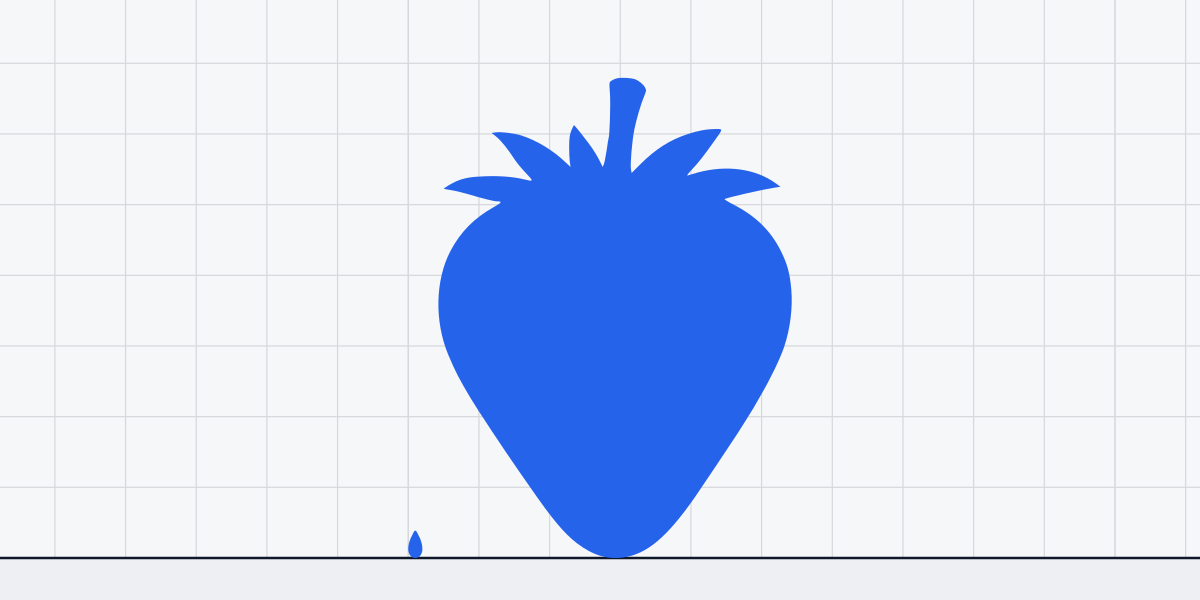
A typical ripe strawberry is about 5 cm (2 in) across at its widest point and can carry roughly 200 visible specks (opens in a new tab). Each speck is an achene, a tiny fruit containing a seed.
The count answers the everyday question, but the word “seed” misses a useful detail: each visible mark has its own seed tucked inside a separate fruit. The red, juicy strawberry is the part that grows around those fruits.
The quick estimate: about 200
A medium strawberry has about 200 achenes, according to the Cal Poly Strawberry Center’s anatomy guide (opens in a new tab). That gives you a sensible starting point when looking at a berry in a bowl or at a market. The surface marks are small, close together and spread over a curved shape, so a quick glance can easily miss some.
A sesame seed is about 2 mm (0.079 in) long. Set one beside a strawberry and the size difference is clear: the berry is about 2.1 times the diameter of a large coin, while the visible achenes are tiny marks across its skin. The sesame seed is a size reference, not a stand-in for a strawberry achene.
How to make a rough count
Start with a ripe berry about 5 cm across and take a clear photograph in bright, even light. Focus closely enough to make the individual specks distinct. Count across the visible half, moving from one patch to the next rather than jumping around the surface. A rough tally near 100 on that visible half would lead to a working total near 200.
The camera view hides the far side, so turn the berry and continue the tally there. To avoid counting a patch twice, mark each scanned area on a printout or keep a simple sketch beside the photograph. Where two views overlap, use a recognizable speck as a boundary: stop at that mark in one view and begin just beyond it in the next. The curved tip and shoulders need a careful look because specks can disappear around the edge.
This method is useful when the goal is to judge whether a berry is near the typical count, not to produce a laboratory total. The specks are not arranged in tidy rows, and individual strawberries differ in shape and surface coverage. A 5 cm strawberry is about 8.3 times as long as a grain of rice; the rice comparison helps you picture the whole fruit, not count its much smaller achenes. Estimation tips can help with other crowded or curved objects.
What the strawberry’s specks really are
Each speck is an achene, a small dry fruit that contains a seed. The botanical fruit is the achene itself; the red part people eat is swollen flower tissue. That makes the familiar phrase strawberry seeds understandable, even though it gives the tiny fruits on the outside the wrong name.
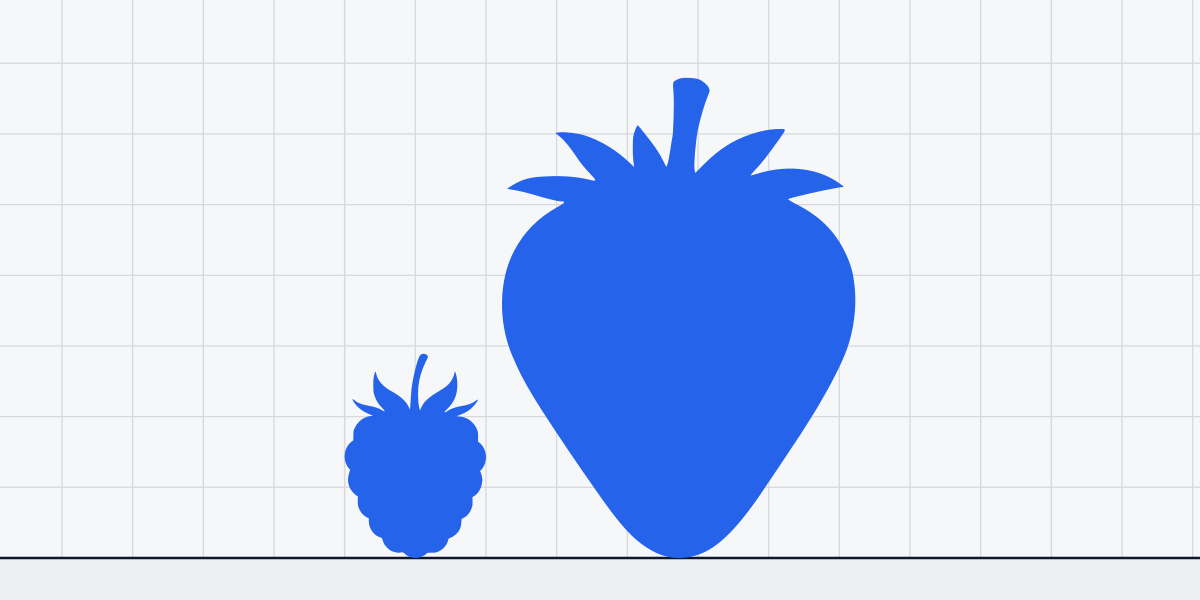
A strawberry’s arrangement differs from a raspberry, whose small drupelets cluster around a central core. The strawberry’s achenes sit individually across the outer surface, above the fleshy base of the flower. A raspberry looks like a cluster of small rounded units; a strawberry looks like one red body dotted with many separate fruits.
How pollination helps a strawberry grow
The visible achenes develop from fertilised ovules in the flower (opens in a new tab). As they develop, they produce growth signals, including the plant hormone auxin. Those signals encourage the nearby receptacle, the flower tissue beneath the achenes, to expand (opens in a new tab). The University of California Agriculture and Natural Resources explanation of strawberry growth (opens in a new tab) describes this link between achene development, hormone production and growth of the fleshy part.
When fertilisation is uneven across a flower, achenes may develop unevenly too. The sections of receptacle beside them can then receive different growth signals, leaving one area less swollen than another. That is one reason a strawberry can grow lopsided rather than into a symmetrical heart shape. The pattern of specks is therefore connected to the shape of the red flesh beneath them.
Achene count does not provide a direct formula for a berry’s final size. Different strawberry varieties naturally grow to different fruit sizes (opens in a new tab), and growing conditions also affect how large the receptacle becomes (opens in a new tab). Still, the outside offers a visible trace of the flower’s development: separate fruits mark the places where fertilisation helped set growth in motion.
The next strawberry you eat is a red, swollen flower base wearing about 200 individual fruits.
Related sizes
Things this article is about, with their sizes.
Sources
- Cal Poly Strawberry Center: Test your strawberry anatomy skills, Part 2 (opens in a new tab) strawberry.calpoly.edu
- University of California Agriculture and Natural Resources: Growth of the Strawberry Fruit Related to Flower Ovule Number and Auxin Production (opens in a new tab) ucanr.edu
- Encyclopaedia Britannica, “Strawberry”; Royal Horticultural Society, “Strawberries”
- Encyclopaedia Britannica, “Sesame”; USDA FoodData Central, “Seeds, sesame seeds, whole, dried”
- Encyclopaedia Britannica, “Raspberry”; Royal Horticultural Society, “Raspberries”
- Frontiers in Plant Science: Auxin Coordinates Achene and Receptacle Development During Fruit Initiation in Fragaria vesca (opens in a new tab) frontiersin.org
- University of Minnesota Extension: Small or misshapen strawberries (opens in a new tab) extension.umn.edu
- Oregon State University Extension Service: Strawberry Cultivars for Western Oregon and Washington (opens in a new tab) extension.oregonstate.edu