 English
 العربية
 Deutsch
 Español
 Français
 हिन्दी
 Bahasa Indonesia
 Italiano
 日本語
日本語 한국어
한국어 Polski
 Português (Brasil)
 Русский
 Türkçe
 Українська
 简体中文
简体中文Learn
How many kernels are on an ear of corn?
An ear of corn, a cereal grain carries about 400 to 1,000 kernels (opens in a new tab). To estimate a particular ear, count the rows around the cob, count kernels along a representative row, then multiply. For example, 16 rows with 40 kernels per row give an estimate of 640 kernels.
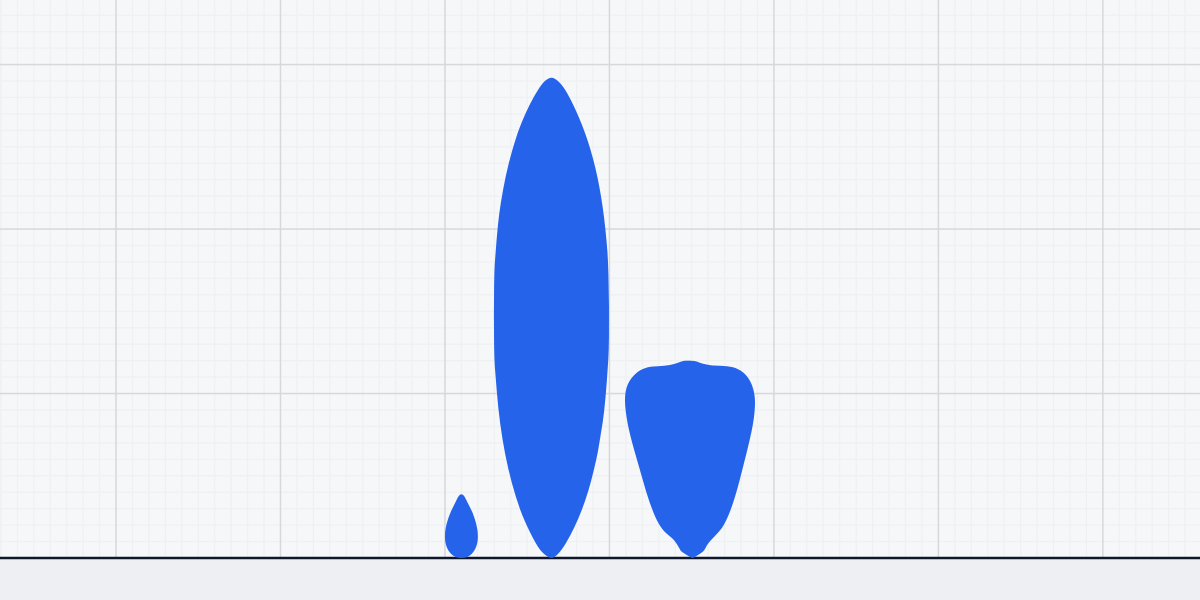
A dried corn kernel is 1.2 cm (0.47 in) long, about 1.7 times the length of a 7 mm (0.28 in) rice grain. A sesame seed is 2 mm (0.079 in) long. The University of Illinois describes (opens in a new tab) a corn kernel as a botanical fruit called a caryopsis, a dry fruit whose seed coat is fused to the fruit wall.
The quick answer: hundreds, not dozens
The total depends on two features of the cob: how many rows circle it and how many kernels fill each row. Rows run lengthwise from the base toward the tip, while the count of kernels in a row reflects how far that row extends. The 400-to-1,000-kernel range is an estimate, not a fixed total for every ear.
Counting the whole cob is unnecessary for a quick estimate. The row total gives one part of the multiplication; a count along a row gives the other. When rows differ in length, count kernels along several rows and average those counts before multiplying by the total number of rows. That average helps prevent a particularly full or short row from standing in for the entire cob.
Start by counting the rows around the cob
Pull back the husk and look at the kernels from the base of the cob toward its tip. Each lengthwise line of kernels is a row. Turn the cob as you count, tracing each line all the way around so you do not count the same row twice or overlook one on the far side. Touch the starting row with a fingertip, or make tally marks on scrap paper as you go.
Rows usually come in an even number because each row starts as part of a pair during ear development (opens in a new tab). If your tally is odd, trace the rows again before treating that count as correct. Closely packed kernels can make the boundary between neighboring rows hard to follow, especially under the husk or near the tip. A second pass around the cob can help you spot a missed line.
Count along the rows, then multiply
Choose a clear row and count its kernels from the base to the tip. A line of kernels is easier to follow if you rotate the cob slowly and keep your place as you move along it. Then multiply your row count by the total number of rows around the cob. In the opening example, 16 rows times 40 kernels per row produced an estimate of 640 kernels.
One row may not represent the rest of the cob. Kernels can taper toward the tip, a row can end short, and gaps can appear where kernels did not develop. If your chosen row has an unusually bare tip or looks fuller than its neighbors, count another row and compare their lengths and kernel counts. A sample that includes rows from different sides of the cob is a better guide than a single unusually full line.
The Iowa State Extension guide to corn yield estimates (opens in a new tab) uses row counts and kernels per row to estimate an ear's total, while accounting for uneven rows and incomplete kernels. For a more representative estimate, count kernels in several rows rather than relying on the fullest-looking one. Add those row counts and divide by how many rows you sampled to get an average; multiply that average by the total number of rows around the cob.
For example, suppose sample rows contain 34 kernels, 36 kernels, and 35 kernels. Their average is 35 kernels per row. If the cob has 18 rows, multiplying 18 by 35 gives an estimate of 630 kernels. Those figures are an arithmetic example, not a claim about a typical ear. The North Carolina State Extension counting method (opens in a new tab) also recommends counting rows, counting kernels along rows, and checking more than one ear when estimating a crop.
Why ears have different kernel counts
An ear's total changes with both the row count and the number of kernels in each row. Gaps from incomplete pollination can lower the count, and rows that stop short of the tip contribute fewer kernels than full-length rows. Corn kernels develop from fertilized flowers; when pollen does not reach some of those flowers, bare spaces can remain on the cob.
The method estimates a whole ear from a sample, so it works best when the sampled rows resemble the others. If the cob has noticeably different row lengths, count kernels along more rows and use their average instead of trusting the fullest row. A visible gap is not a kernel, and a tapered tip is still part of the row you are estimating.
Peel back the husk, tally the rows, and count kernels along several rows before multiplying. Then compare your estimate with the range above and see how close your cob comes.
Related sizes
Things this article is about, with their sizes.
Sources
- University of Illinois Urbana-Champaign, Agricultural & Biological Engineering: New method analyzes corn kernel characteristics (opens in a new tab) abe.illinois.edu
- Iowa State University Extension and Outreach: Corn Yield Estimates (opens in a new tab) crops.extension.iastate.edu
- North Carolina State University Extension: Using Kernel Counts to Estimate Corn Yield Potential (opens in a new tab) corn.ces.ncsu.edu
- Purdue University Agronomy Extension: Ear Size Determination in Corn (opens in a new tab) agry.purdue.edu
- Encyclopaedia Britannica, “Rice”; USDA FoodData Central, “Rice, white, long-grain, regular, raw”
- Encyclopaedia Britannica, “Sesame”; USDA FoodData Central, “Seeds, sesame seeds, whole, dried”