 English
 العربية
 Deutsch
 Español
 Français
 हिन्दी
 Bahasa Indonesia
 Italiano
 日本語
日本語 한국어
한국어 Polski
 Português (Brasil)
 Русский
 Türkçe
 Українська
 简体中文
简体中文Learn
How many grains of sand are on Earth?
A rough estimate — reasoning from the length, width and depth of the world's sandy coastline — puts the grains on the world's beaches at about 4 × 10²⁰ (opens in a new tab). That is a beach estimate, not a census of every grain on Earth: it does not add up all the sand in the world's deserts.
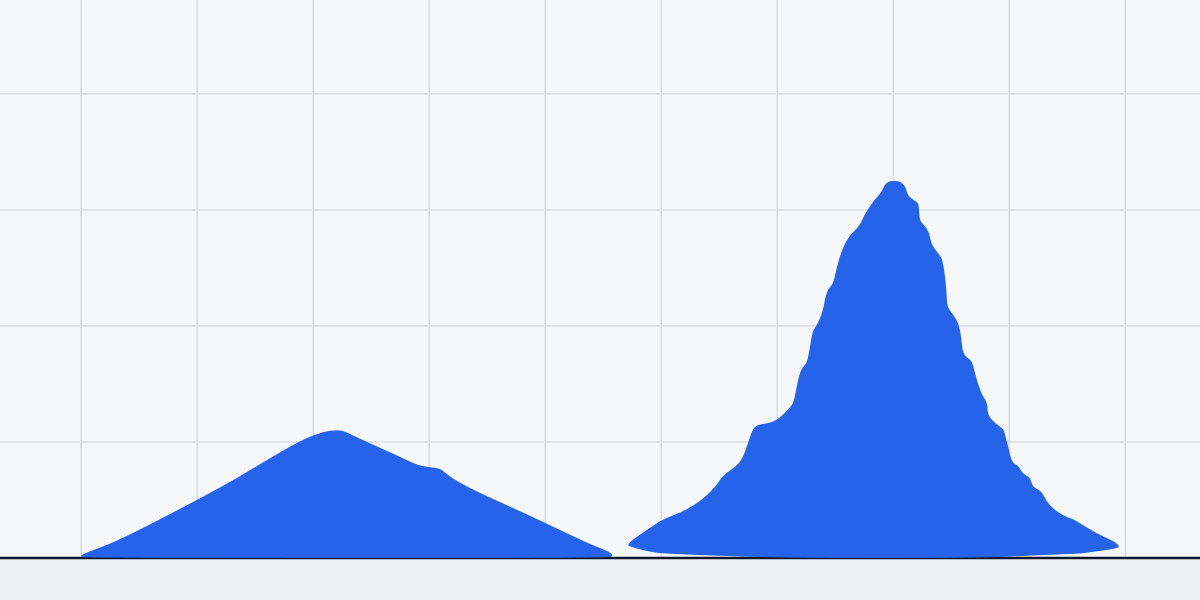
The Big Daddy Dune rises 325 m (1,070 ft) above the plain at Deadvlei in Namibia's Namib Desert, according to the Sossusvlei visitor page (opens in a new tab). In France, Dune du Pilat reaches 110 m (361 ft), according to its visitor dimensions page (opens in a new tab). Those dunes make a striking pair, but their height alone says little about their total volume.
A dune's volume depends on its length, width, slopes and depth, not just its highest point. Wind shifts sand across both landscapes, changing where a dune's edges fall. To estimate grains, researchers need a volume of sand first, then a way to divide that volume into individual grains.
How a grain becomes a counting unit
A medium grain of sand is about 500 µm across. That gives the estimate a working unit, though real beaches mix grains of different sizes and shapes. A 7 mm rice grain is about 14 medium grains of sand end to end. One rice kernel makes a tangible stand-in for a short row of sand grains.
A simple grid shows how grain size affects the count. A 500 µm grain is 0.5 mm across; a centimetre is 10 mm. In a cube-cell sketch, that gives about 20 grain-widths along each edge of a cubic centimetre, or roughly 8,000 grain positions in all. This is a way to follow the arithmetic, not a claim that beach grains pack into a perfect grid.
Actual grains are irregular, and the gaps between them take up space too. A cubic centimetre of loose sand therefore holds fewer grains than the grid's count of positions. Grain size also matters sharply: if a grain's diameter doubles, its volume grows about eightfold, so fewer grains fit in a fixed volume. The Dust & Particles scale helps put these grains between visible objects and the much smaller particles of the microscopic world.
What the beach estimate counts
The Scientific American explanation of beach-sand estimates (opens in a new tab) describes the basic method: estimate a volume of beach sand, then divide by the volume of an average grain. Working from an estimated 750,000 km of sandy coastline, it arrives at about 4 × 10²⁰ grains. That figure is an estimate built from assumptions about sand volume and grain size, not a count made along every shoreline.
The calculation can also be read in reverse. Using the simple grid above, 1 km³ of sand contains about 8 × 10¹⁸ grain positions: a cubic kilometre contains 10¹⁵ cubic centimetres, multiplied by about 8,000 positions per cubic centimetre. A beach estimate of about 4 × 10²⁰ grains is therefore on the order of 50 km³ of sand in this simplified model. Irregular shapes and gaps change the result, but the conversion shows how a huge grain count can come from a volume that fits into a single landscape-scale unit.
For an independent estimate, the beach calculation would need a global sandy area and an average depth for the sand being counted. Area multiplied by depth gives volume; volume multiplied by grain density gives the count. A shoreline's length alone is not enough, because a narrow beach and a wide beach contribute different amounts of sand. The University of Kansas astronomy reading (opens in a new tab) explains this volume-divided-by-grain method, but no single beach width or depth describes every coast.
Why deserts change the question
The word “desert” does not mean an unbroken sea of sand. Rocky ground, gravel plains and bare mountains cover large areas of deserts, while dunes and sand seas occupy others. Big Daddy rises above Deadvlei's white clay pan, a reminder that even a famous dune sits within a landscape that is not all sand.
To add desert deposits to a beach total, a global estimate would need the area of sandy terrain and its average sand depth, counted separately from beaches. Dune height does not supply either number. Big Daddy's 325 m height describes its rise above the surrounding plain, while Dune du Pilat's 110 m height describes its highest measured point. Neither measurement tells us how much sand lies beneath the rest of a dune field.
The beach-only estimate is useful because it has a defined subject and a volume-based method. Extending it to all sand in deserts would require choosing which deposits count and measuring their depth, not simply adding the heights of well-known dunes. Without that inventory, presenting about 4 × 10²⁰ grains as a total for all Earth's sand would overstate what the beach estimate establishes.
How the count compares with stars
The familiar comparison is with stars in the observable universe. Their number is commonly estimated at up to one septillion — a 1 followed by 24 zeros (opens in a new tab), based on estimates of galaxies and the stars they contain rather than a direct tally. The Galaxies scale puts that comparison in context: astronomers infer enormous totals from objects too distant to count individually.
Star counts vary by method, though, and that matters here. The same Scientific American analysis behind the beach-sand figure works out its own, smaller star count too — about 10 million stars per galaxy across some 2 trillion galaxies, or roughly 2 × 10¹⁹ stars — and finds that beach sand actually outnumbers that figure by about 20 to 1. Measured against NASA's larger, one-septillion estimate, stars come out ahead instead. Either way, the true count for every grain on Earth would be larger still than the beach-only figure, because the world's desert sand has not been added to it.
Related sizes
Things this article is about, with their sizes.
Sources
- Sossusvlei.org: Big Daddy Dune (opens in a new tab) sossusvlei.org
- Dune du Pilat / Pyla sur Mer: Dimensions - Dune du Pilat | Pyla sur Mer (opens in a new tab) dunedupilat.com
- Scientific American: Do Stars Outnumber the Sands of Earth’s Beaches? (opens in a new tab) scientificamerican.com
- University of Kansas: Astronomy: The Cosmic Perspective, Chapter 1 reading (opens in a new tab) crossfield.ku.edu
- NASA Science: Stars (opens in a new tab) science.nasa.gov
- Encyclopaedia Britannica, “Rice”; USDA FoodData Central, “Rice, white, long-grain, regular, raw”