 English
 العربية
 Deutsch
 Español
 Français
 हिन्दी
 Bahasa Indonesia
 Italiano
 日本語
日本語 한국어
한국어 Polski
 Português (Brasil)
 Русский
 Türkçe
 Українська
 简体中文
简体中文Learn
How can you estimate jelly beans in a jar?
A jar holding about 1,180 cm³ and beans averaging 0.8 cm³ each would hold roughly 1,000 jelly beans after allowing for gaps. Estimate the count by dividing the jar’s filled volume by the average volume of a bean, then multiplying by about two-thirds (opens in a new tab).
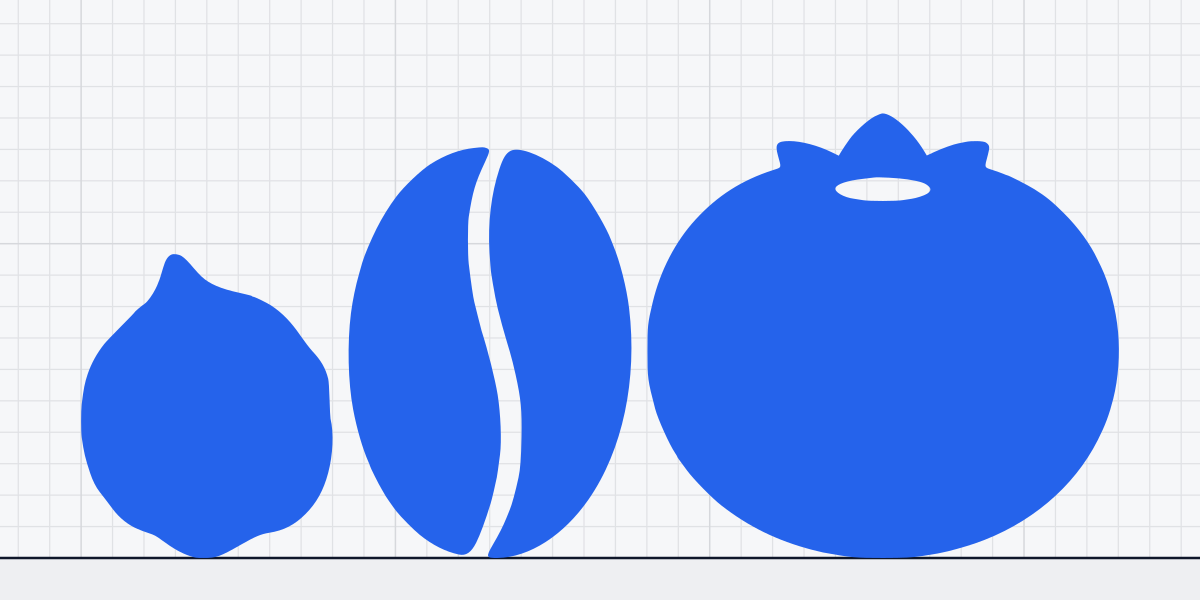
Small differences in sweet size matter when estimating a whole jar. A blueberry is about 1.5 cm (0.59 in) wide, according to the U.S. Forest Service’s highbush blueberry review (opens in a new tab). A dry chickpea is 8 mm (0.31 in) across, as described in a review of chickpea biology (opens in a new tab). A roasted coffee bean is about 9 mm (0.35 in) long. That is about 1.5 times the length of a grain of rice. These foods are size anchors, not stand-ins for jelly beans: their shapes, and therefore their volumes, differ.
Measure the space the sweets actually fill
Measure the jar’s inside dimensions, not its outside, and measure only up to the sweets. The empty space above the candy does not count. For a cylindrical jar, multiply π by the inside radius squared, then by the filled height.
For a worked example, imagine a jar with an inside diameter of 10 cm and sweets reaching a height of 15 cm. The radius is 5 cm, so the filled volume is about 1,180 cm³, or 1.18 L. This is the space taken up by both the beans and the air between them, not the volume of candy alone.
For a rectangular jar, multiply its inside length by its inside width and the height filled with sweets. For a jar with sloping shoulders or a narrow neck, estimate the volume in sections, such as the straight-sided part and the tapered part, then add them. That gives a better estimate than treating the whole jar as a cylinder.
Estimate the volume of a jelly bean
Length alone cannot tell you how many beans fit. A bean’s volume includes its thickness as well as its length and width. For a rough working model, picture an ellipsoid-like bean about 2 cm long, 1 cm wide and 0.8 cm thick. Its approximate volume is 0.8 cm³. The rounded ends matter: multiplying the length, width and thickness as if the bean were a box would overstate its volume.
You can replace that visual estimate with a water-displacement measurement. Use a narrow graduated container and a sample of beans chosen from across the bag. Record the starting water level, lower the counted sample until it is submerged, then read the new level promptly. Water can soften a sugary shell, so don’t leave the beans sitting in the container.
For example, if the water rises from 100 mL to 116 mL, the sample displaces 16 mL. Divide that rise by a sample of 20 beans: the average is 0.8 mL per bean, or 0.8 cm³. A millilitre and a cubic centimetre are equivalent units (opens in a new tab). The result averages the actual shape and thickness of the sample, instead of relying on how large a bean looks. Use that measured average in place of the illustrative 0.8 cm³ when you calculate your own jar.
Correct for the empty space between sweets
Dividing the jar’s volume by one bean’s volume assumes the candy fills every part of the jar. Poured beans settle against one another, but their rounded sides leave gaps too small for another bean. Multiply the raw count by about two-thirds (opens in a new tab), allowing for roughly one-third of the filled space to be air.
In a 100 cm³ pile, about 67 cm³ would be candy and about 33 cm³ would be gaps. Bean shape and how the jar is filled affect how tightly the sweets settle, so two-thirds is a practical estimate, not a fixed rule for every jar.
Put the correction to work
Use the example jar’s 1,180 cm³ volume and the estimated bean volume of 0.8 cm³. Dividing gives about 1,475 beans before allowing for gaps. Multiplying that raw count by two-thirds gives about 980 beans. Round the result to roughly 1,000 jelly beans, rather than implying the calculation can reveal an exact count.
A 1.18 L jar is 1,180 cm³, the same volume used in the example. Keep both measurements in matching units: divide cubic centimetres by cubic centimetres, or millilitres by millilitres. Mixing litres and cubic centimetres can throw the result off by a large factor.
Fit the estimate to the jar in front of you
Measure the real fill height, not the jar’s full height. If the sweets form an uneven surface, estimate the average level they reach rather than measuring to the highest bean. Then use the jar’s actual inside dimensions and your sample’s average volume in the calculation.
For more ways to make everyday estimates, see these estimation tips. Every gap you leave between the beans is part of the jar your estimate must account for.
Related sizes
Things this article is about, with their sizes.
Sources
- USDA Forest Service Research and Development: Vaccinium corymbosum, highbush blueberry (opens in a new tab) research.fs.usda.gov
- National Center for Biotechnology Information (PMC): Chickpea (Cicer arietinum L.) Biology and Biotechnology: From Domestication to Biofortification and Biopharming (opens in a new tab) pmc.ncbi.nlm.nih.gov
- National Coffee Association, “The Coffee Plant”; Encyclopaedia Britannica, “Coffee”
- Wolfram MathWorld: Random Close Packing (opens in a new tab) mathworld.wolfram.com
- NIST Office of Weights and Measures: SI Units — Volume (opens in a new tab) nist.gov