 English
 العربية
 Deutsch
 Español
 Français
 हिन्दी
 Bahasa Indonesia
 Italiano
 日本語
日本語 한국어
한국어 Polski
 Português (Brasil)
 Русский
 Türkçe
 Українська
 简体中文
简体中文Learn
What would a billion grains of rice look like?
A billion (opens in a new tab) long-grain rice kernels could make a loose heap of about 34 cubic metres, enough to bury a compact car under a modeled cap of rice. A long-grain rice kernel measures about 7 mm (0.28 in) tip to tip; estimating the heap means adding the grain’s other dimensions and the air between kernels.
A grain laid end to end
Lay the kernels end to end, with no gaps, and a billion grains at 7 mm apiece would form a line about 7,000 km (4,300 mi) long. That is a length calculation. A heap needs a different one, because kernels touch along their sides and leave spaces between them.
A rice grain is the seed of a grass, and milling removes its hull to produce brown or white rice. Rice belongs with grains and cereals. UC Davis’s rice grain guide (opens in a new tab) describes the kernel’s form and parts; the USA Rice variety guide (opens in a new tab) explains how kernel size and shape distinguish varieties.
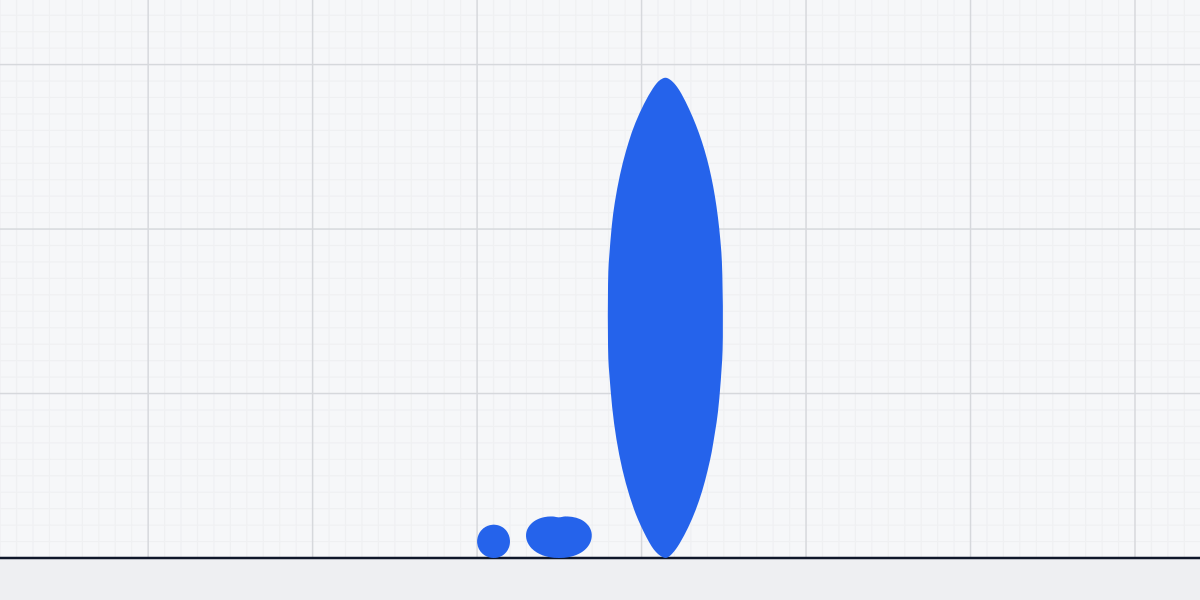
A mustard seed is about 2 mm wide, while a lentil is about 4 mm across. They are familiar seed-sized objects beside the longer rice kernel, but a grain’s length alone does not say how much space it occupies.
A rice grain is about 14 times as long as a medium grain of sand. The rice measurement runs from tip to tip; a grain of sand is measured across its width. That difference matters when imagining a heap: end-to-end lengths add along a line, while volume depends on the space inside each kernel and the gaps around it. A 7 mm length is a useful starting point, not a measurement of the pile.
From kernel to loose heap
To estimate a kernel’s volume, model its tapered form as a stretched ellipsoid. Use the measured length of about 7 mm, with an assumed width of 2.7 mm (opens in a new tab) and thickness of 1.9 mm (opens in a new tab). An ellipsoid’s volume is pi divided by six times its length, width and thickness (opens in a new tab), giving about 19 cubic millimetres per kernel. The width and thickness are assumptions, not measurements from the tip-to-tip figure.
Multiply about 19 cubic millimetres by a billion kernels, and the solid rice occupies about 19 cubic metres. A loose heap also contains air. Assume the kernels fill 50 to 60 percent of the heap’s volume (opens in a new tab); the air gaps bring the total to about 31 to 38 cubic metres. Use about 34 cubic metres as the working heap-volume estimate.
The way grains settle controls how much empty space remains. Kernels poured loosely can sit at different angles; shaking them down changes how closely they pack. The estimation tips use this same practical approach: state the assumptions, then follow what they imply.
Could that heap cover a car?
A compact car might measure about 4.5 m long, 1.8 m wide and 1.5 m high (opens in a new tab). To give the heap a shape, model it as a rectangular frustum: a flat crown above the car, with sides sloping down to a wider base.
For a rectangular frustum, volume equals its height times the sum of the base area, crown area and the square root of their product, divided by three (opens in a new tab). Give the base dimensions of 5.8 m by 3.4 m, the crown dimensions of 4.5 m by 1.8 m, and a height of 2.5 m. Those dimensions produce a volume of about 34 cubic metres. The crown spans the car’s assumed footprint and rises above its roofline.
The frustum is a clear shape for the estimate: a broad top with sloping shoulders, rather than a box with vertical walls. Rice spreads beyond the car’s sides as the heap narrows toward the ground, while the flat crown covers the vehicle.
What would the rice weigh?
As a separate check, assume a dry rice grain weighs about 20 milligrams (opens in a new tab). A billion grains at that assumed weight would weigh about 20,000 kg (20 metric tonnes). The mass confirms the scale of the load; it does not determine the heap’s outline.
Rice varieties differ in kernel size and shape, and the way grains settle changes the air gaps. Those are the inputs that move the volume estimate, while the 7 mm tip-to-tip measurement remains the starting length. The modeled cap rises to about 2.5 m, above a standard interior doorway measuring 2 m (6.6 ft), with the car sealed beneath its sloping shoulders.
Related sizes
Things this article is about, with their sizes.
Sources
- University of California, Davis: Rice Grain Varieties (opens in a new tab) labs.plb.ucdavis.edu
- USA Rice: U.S. Rice Varieties (opens in a new tab) usarice.com
- Encyclopaedia Britannica, Mustard plant; McCormick Science Institute, Mustard
- Encyclopaedia Britannica — Lentil; USDA FoodData Central — Lentils, mature seeds, raw
- Merriam-Webster: “Billion” (opens in a new tab) merriam-webster.com
- Evaluation of physical properties of rice used in traditional Kyrgyz cuisine (NCBI/PMC) (opens in a new tab) pmc.ncbi.nlm.nih.gov
- Wolfram Formula Repository: Ellipsoid Volume (opens in a new tab) resources.wolframcloud.com
- Bioscience Biotechnology Research Communications: Geo-gravimetric Properties of Polished Rice (opens in a new tab) bbrc.in
- CarsGuide: 2024 Toyota Corolla Dimensions (opens in a new tab) carsguide.com.au
- Wolfram MathWorld: Pyramidal Frustum (opens in a new tab) mathworld.wolfram.com
- Control of Thousand-Grain Weight by OsMADS56 in Rice (NCBI/PMC) (opens in a new tab) pmc.ncbi.nlm.nih.gov